
The Filecoin Virtual Machine (FVM) launched on March 14, 2023 (pi day). There is nothing else in crypto quite like the FVM. It allows developers to bind payments and DeFi to real world primitives on the Filecoin network, starting with storage. Over time, we expect the FVM to also allow for direct programmability of bandwidth and compute resources as well.
We initiated a FIL position leading up to the FVM launch. In our research to understand what developers can build with it we discovered what became our first investment in the Filecoin ecosystem: GLIF.
Today, we’re excited to announce that Multicoin Capital has led a $4.5M round in GLIF—the foundational DeFi primitive of Filecoin, and crypto’s first liquid leasing protocol.
The Foundational DeFi Primitive of Filecoin
Today, the primary function of the Filecoin network is file storage. Storage providers (SPs) must pledge FIL as collateral on behalf of their customers.
In order to provide storage, SPs must provide two forms of capital: hardware and financial capital (in the form of FIL). GLIF uses the FVM to create a permissionless market between people who own FIL and SPs who have hardware. GLIF addresses the core capital efficiency problem in the Filecoin ecosystem, similar to the roles Jito and Lido play in their respective ecosystems. Specifically, GLIF allows FIL holders to deposit FIL to a liquidity pool and receive iFIL in return. iFIL operates as a liquid staking token: it accrues rewards from SPs over time. SPs can lease FIL from the liquidity pool to use for pledging based on the amount of collateral they lock in the protocol. After leasing, SPs must make weekly payments back to the pool. These payments serve as the rewards for liquidity providers. The mechanisms employed by GLIF operate like a crypto “lease” because of the complexities of Filecoin’s underlying cryptoeconomics.
Flexible Foundation
An interesting and under-observed aspect of GLIF is the protocol’s ability to deploy several, interoperable capital markets with their own custom assets and rules (today there is just one market). This feature opens the door for GLIF to engage with LPs and SPs in bespoke ways and horizontally scale to fit new use cases as Filecoin matures.
For example, GLIF could deploy a custom pool specifically for lowering the barrier of entry for new SPs joining the network, a stablecoin-based pool that leverages a SP’s storage deal flow as borrowing collateral, and/or a pool that deploys capital to SPs that are storing specific data sets or running specific compute programs. Eventually, we imagine a Filecoin economy where many bespoke pools exist to incentivize niche or specific use cases when it comes to data storage, retrieval, and eventually compute. In this way, GLIF’s architecture is entirely unique and also well equipped to scale alongside Filecoin and the new use cases that will emerge as the FVM matures.
Strong Traction
Today, GLIF is the leading DeFi protocol on Filecoin, with roughly 10M FIL being lent, and 8M FIL being leased.
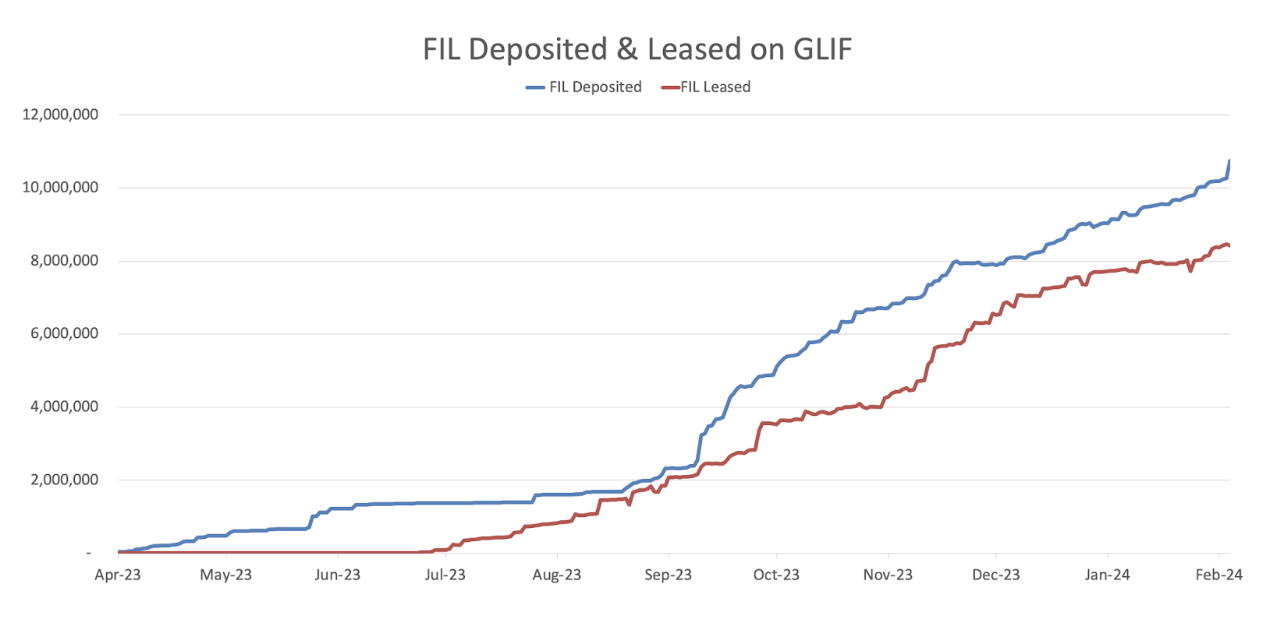
Source: GLIF team
Filecoin Ecosystem Leaders
The GLIF team—led by Jon Schwartz and Peter Andersen—has been building foundational products in the Filecoin ecosystem since 2019. Prior to launching GLIF’s liquid leasing protocol, they built the first web wallet for Filecoin’s Mainnet, the multisig wallet used for Filecoin’s SAFT token distribution (which is still used to this day by Protocol Labs and the Filecoin Foundation to manage payments), the de facto RPC service for Filecoin (has handled over 85 million requests per day!), and several other critical apps and tools for the Filecoin network.
We have loved working with Jon and Peter as they build out the foundational DeFi primitives that will power Filecoin. To learn more about how GLIF’s liquid leasing protocol works, please head to GLIF’s website to learn more about the project and FIL leasing opportunities.