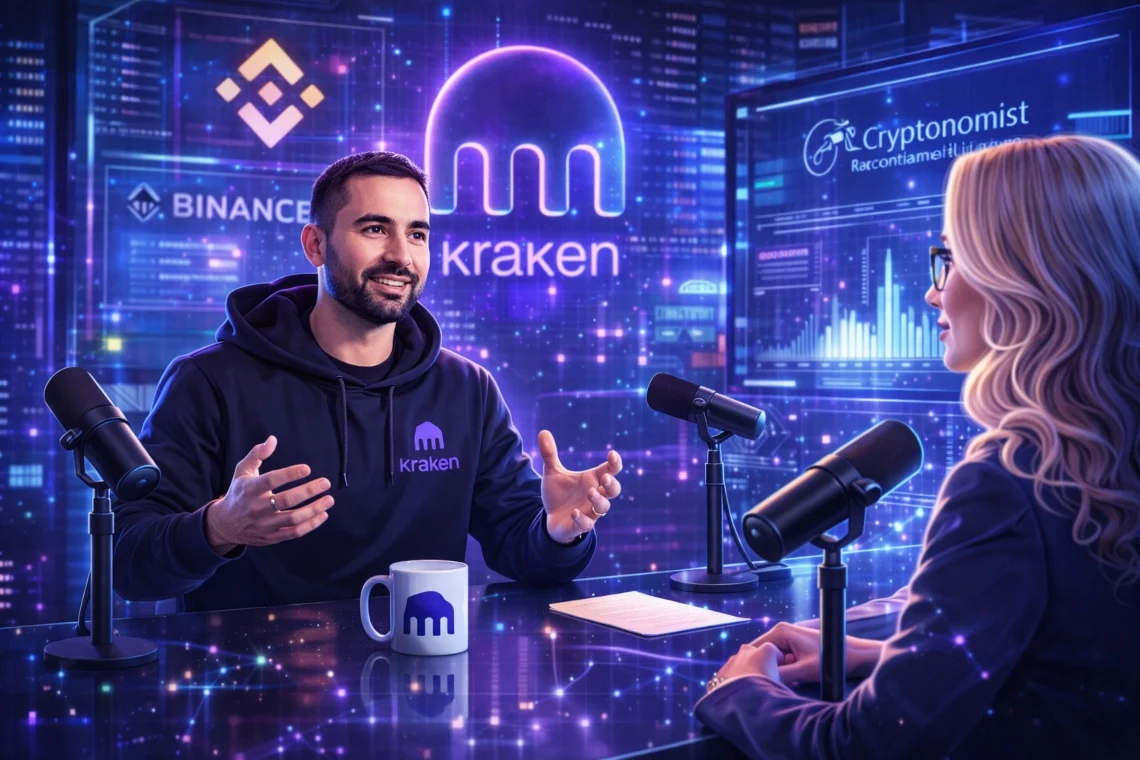
From the cultural difference between Binance and Kraken to the evolution of the retail audience, covering AI, market cycles, and career in the crypto sector: the interview with Lorenzo Cappone.
Marketing in the crypto sector is entering a new phase. After years of hype, explosive growth, and aggressive communication, the audience has changed — and brands must change with it.
This is one of the key messages that emerged from the interview between Amelia Tomasicchio, founder of Cryptonomist, and Lorenzo Capone, currently at Kraken and formerly at Binance, among the most experienced Italian managers in the retail growth of exchanges.
The meeting provides a rare insider’s view of the industry: corporate culture, audience evolution, use of artificial intelligence, and crypto market dynamics in 2026.
Binance vs Kraken: speed versus identity
One of the most intriguing parts of the interview concerns the cultural difference between the two giants of the industry.
According to Capone, Binance epitomizes speed and aggressive execution:
“Binance is pure execution, scale, speed. Kraken, on the other hand, is more reflective: branding, values, identity. It is a more organized structure in terms of marketing.”
Kraken, a company historically perceived as solid and compliance-first, has a still limited presence in Italy and Southern Europe. This very absence has represented an opportunity for Capone:
“The brand is strong, the company is solid, but the local presence is almost nonexistent. I saw a great opportunity to make it known.”
It’s not just about market strategy, but also operational philosophy. Binance was created as a hyper-scalable machine; Kraken, with its American roots, prioritizes structure and brand consistency. Two opposing models that reflect different approaches to growth.
The crypto audience has changed
If there’s one point Capone is clear about, it’s this: the retail crypto audience is no longer naive.
“Today, people have a shield. They immediately recognize when someone is paid to say something. They understand when there’s shill, when there’s FUD, when there’s forced marketing.”
According to Capone, many medium to small exchanges still make a fatal mistake: underestimating the intelligence of the public.
After years of market cycles, failures, scandals, and speculative bubbles, users have developed a strong critical sense. Superficial or manipulative communication not only no longer works — it risks damaging the brand.
This change necessitates a thorough overhaul of crypto marketing:
- less hype
- more transparency
- real education
- consistent branding
AI in Marketing: Tool, Not Shortcut
Another central theme is artificial intelligence. Capone is clear: AI will not replace marketers, but it will raise the bar.
“It will not replace anyone. On the contrary, it will enhance the creativity needed for effective marketing.”
The issue isn’t AI itself, but its superficial use. Today, many brands chase trends without strategy, producing easily recognizable “cringe” AI content.
The public, once again, takes notice.
“They can tell in milliseconds when content is poorly generated with AI.”
The winning approach is holistic: integrating AI tools into workflows without distorting the brand’s human message.
Crypto Marketing in 2026: Education or Entertainment?
The marketing of retail exchanges today faces a segmentation challenge. The audience is vast and heterogeneous: experienced users coexist with novices.
According to Capone, the winning strategy remains diversification:
“A mix is needed. There are those who speak the crypto language and those who need basic financial education.”
There is no longer a dominant platform. Instagram, Twitter/X, TikTok, and YouTube require different languages and strategies. The challenge is not only creative but also operational: the marketing teams of exchanges are often made up of very few people.
Managing a multiplatform presence is a matter of priorities and resources.
Working in the Crypto Sector Today: End of the Easy Era
Another significant step concerns employment in the sector.
In 2021, simply labeling oneself as a “Web3 enthusiast” on LinkedIn was enough to secure interviews. By 2026, the landscape is radically different.
“Today you need to deliver value. Titles matter little. What counts is the track record.”
Companies seek tangible results, not generic enthusiasm. Determination and personal initiative make the difference.
Capone shares a telling anecdote: a candidate who, after an interview, sent a 40-page document to develop an idea discussed during the call.
“What distinguishes people is hunger.”
The sector is more selective, yet also more professional. The impulsive hiring of the 2021 cycle has given way to a logic of efficiency and sustainability.
Crypto Market: Cycles and Human Psychology
In the market, Capone avoids making predictions, but notes a historical constant: it’s not just the price that is cyclical — human behavior is as well.
“Every cycle tells the same story. Hype at the top, panic at the bottom.”
According to him, bear markets are the times to study and build skills, not to chase the price.
The “Bitcoin is dead” narrative continues to resurface with every correction, despite a fifteen-year history of resilience.
A Maturing Sector
The interview portrays a more mature crypto sector compared to the past:
- more critical audience
- more structured brands
- more selective hiring
- less improvised marketing
The era of blind enthusiasm gives way to professionalization.
For those entering today, the opportunities remain vast — but they require real skills, strategic vision, and adaptability.
As Capone summarizes:
“This is the right time to study. Not when the market explodes.”