16 Feb Bitfinex Alpha | BTC Stabilises as Early Signs of Optimism Emerge
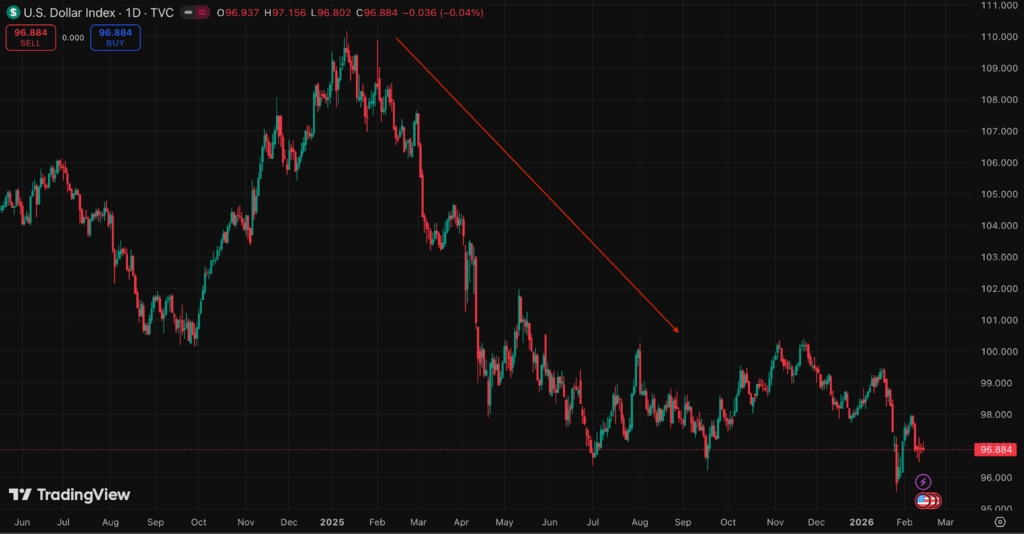
Bitcoin is attempting to stabilise after the 5 February capitulation event, which drove the price to a local low of $60,100. The macro backdrop has turned constructive. Headline CPI cooled to below expectations, reinforcing the narrative that disinflation is gaining traction. Treasury yields declined, the dollar softened, and rate markets repriced toward three potential cuts in 2026, with April increasingly favoured for the first move. For non-yielding assets such as Bitcoin, this shift in real yield expectations reduces macro headwinds.
Derivatives positioning supports the view that the recent bounce is a stabilisation phase rather than a leverage-driven squeeze. Funding rates have normalised, implied volatility has compressed below 50, and downside skew has moderated from deeply defensive levels to a more balanced -5 delta range. This repricing suggests that traders are no longer aggressively hedging tail risk, but neither are they aggressively re-leveraging.
On-chain data further reinforces the constructive undertone. Approximately 18,400 BTC were withdrawn from exchanges over the past week, continuing the medium-term decline in exchange balances. Long-term holder supply has begun rising again after a multi-month distribution phase, increasing to 14.3 million BTC following a December trough.
Historically, expansions in long-term holder supply have acted as a multi-month leading indicator for price recovery, signalling that stronger hands are re-accumulating into weakness.
ETF flows remain the primary soft spot. Flows briefly turned positive ahead of the CPI announcement, but did not sustain that shift. Institutional demand has not yet reasserted itself in size, and sustained ETF absorption will be required to decisively reclaim higher on-chain resistance levels. Structurally, Bitcoin remains confined between two major valuation anchors. Overhead, the True Market Mean near $78,200 now acts as resistance following repeated failures to reclaim it. Below, the Realised Price near $55,000 defines the deeper value boundary of the cycle. Until price resolves beyond this band, the market is likely to oscillate within a broad consolidation range, with absorption at the lows and distribution near cost-basis resistance.
US macro data at the start of 2026 point to gradual stabilisation rather than renewed acceleration. The Consumer Price Index showed inflation easing to 2.4 percent year-on-year in January, down from 2.7 percent in December, with monthly prices rising 0.2 percent. The moderation was largely driven by lower energy and gasoline costs, while core inflation, which excludes food and energy, rose 0.3 percent on the month and 2.5 percent annually. However, services inflation remains firm at 3.2 percent year-on-year, and tariffs continue to place upward pressure on certain goods, suggesting underlying price pressures have not fully dissipated.
The labour market presents a similar picture of resilience with moderation. January nonfarm payrolls increased by 130,000 and the unemployment rate edged down to 4.3 percent. However, annual benchmark revisions reduced prior job estimates by 898,000, confirming that 2025 hiring was weaker than previously reported. Wage growth remains steady at 3.7 percent year-on-year, but retail sales were flat in December and the control group slipped 0.1 percent, indicating softer consumer demand. Together, the data support a “slow-hire, slow-fire” environment, reducing the urgency for very near-term rate cuts while keeping the Federal Reserve in a patient stance.
Alongside these macro dynamics, the Federal Reserve has shifted from shrinking its balance sheet to expanding it modestly. Funding market indicators, including the spread between the Secured Overnight Financing Rate and the Interest on Reserve Balances (IORB), signalled tightening reserves, prompting renewed Treasury purchases to stabilise liquidity. This expansion is operational rather than stimulative, but expanding reserves tend to support financial conditions, cushion risk assets and apply gradual structural pressure on the US dollar.
In the crypto sector, institutional positioning remains selective. Goldman Sachs reduced its exposure to spot Bitcoin and Ether exchange-traded funds (ETFs) in the fourth quarter of 2025, trimming holdings by 39.4 percent and 27.2 percent respectively, amid a broader market pullback. However, it added positions in newly launched XRP and Solana ETFs, suggesting continued engagement rather than exit.Regulatory developments are also accelerating globally. Hong Kong’s Securities and Futures Commission expanded its framework to allow licensed platforms to offer crypto perpetual contracts to professional investors and clarified rules on margin financing and market-making, while preparing to implement a stablecoin licensing regime in March 2026. In the US, two senators have urged the Treasury to assess whether a $500 million UAE-linked investment in World Liberty Financial warrants a national security review under the Committee on Foreign Investment in the United States. The firm issues the USD1 stablecoin and is seeking a national trust bank charter, placing it at the intersection of digital assets, banking regulation and geopolitical scrutiny.