The crypto industry and investors are awaiting the completion of the US CLARITY Act, which has been delayed amid partisan politics and industry concerns.
The bill would rewrite the rules of the road for the crypto industry, from which agency oversees it to regulations for decentralized finance (DeFi).
Currently, lawmakers in the US Senate are hammering out the details, with significant points of contention. Democrats want a bipartisan bill with ethics provisions and a bailout prohibition that Republicans roundly rejected.
The crypto industry itself has taken issue with some of the provisions. Namely, Coinbase, the largest crypto exchange in the US, doesn’t want a bill that prevents it from offering stablecoin yields. The US bank lobby opposes such yields, saying they threaten deposits and the stability of the financial system.
The bill has gone through several iterations. Here’s a look at how far it’s come:
May 2025: CLARITY comes to Washington
House Committee on Financial Services Chairman French Hill first introduced the CLARITY Act on May 29, 2025.
The goal of the bill, according to the committee, was to establish “clear, functional requirements for digital asset market participants, prioritizing consumer protection while fostering innovation.”
The committee said the bill was needed for several reasons, mainly that digital assets represented the next step in digital financial innovation and that the regulatory status quo was stifling possibilities.
June-July 2025: House passes crypto bill
The House of Representatives moved with uncharacteristic speed on the CLARITY Act. In June, the bill moved through markup sessions in the House committees on agriculture and financial services and was placed on the calendar for a vote on the floor by June 23.
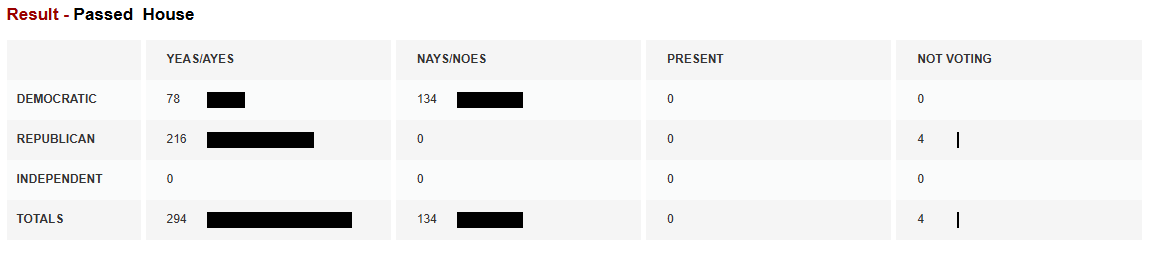
On July 17, the House of Representatives passed the bill, 294-134. The vote found more support among Republicans. Some 216 Republicans supported the bill, none opposed, while four abstained from voting.
There was some bipartisan support: 78 Democrats joined in voting “Yay,” while most of them, 134 Democratic Representatives, voted “Nay.” No Democrats abstained from voting.

With the vote, the bill moved to the upper house, the US Senate, where it has since been under debate.
July-September 2025: Senate starts work
The Senate quickly got underway with work on CLARITY. On July 22, Republican leaders on the US Senate Banking Committee released a draft version of the bill.
The discussion draft would “establish clear distinctions between digital asset securities and commodities, modernize our regulatory framework, and position the United States as the global leader in digital asset innovation.”
Senate Banking Committee Chair Tim Scott was optimistic about the Senate moving just as quickly as the House, giving an initial deadline of Sept. 30, 2025.
October-December 2025: Senators at odds during government shutdown
Democrats on the Senate Banking Committee, including noted cryptocurrency skeptic Senator Elizabeth Warren, were opposed to several parts of the discussion draft.
Warren took issue with how taxes would be treated under the law, saying in a statement that “proposals to clarify crypto’s tax treatment could ultimately give crypto an unfair advantage over other financial products.”
She also said that the proposals “make it harder to track what’s happening in crypto transactions if they are being used for illegal purposes.”
Senate Democrats also came up with their own proposals on how the bill would regulate DeFi. According to partners at Skadden Arps Slate Meagher & Flom, these DeFi rules sought to “leverage existing regulatory frameworks to create a crypto market structure and show Congress’ instinct to retrofit the current system rather than design one built for crypto.”
This was diametrically opposed to Republicans’ and the crypto industry’s vision, which was to create a new, bespoke system for the digital asset industry.
On Nov. 11, 2025, the Senate Agricultural Committee released its own discussion draft of CLARITY. The draft noted that lawmakers were still discussing the idea of which federal agency, the Commodity Futures Trading Commission (CFTC) or the Securities Exchange Commission (SEC), would regulate the industry.
Further hindering progress was the US federal government shutdown from Oct. 1 to Nov. 12 — the longest in history after the previous one that occurred in President Donald Trump’s first term. It only ended after a small group of Senate Democrats voted with Republicans to pass a resolution to temporarily fund the government.
December 2025-January 2026: Markup session, crypto industry gets impatient
Senator Cynthia Lummis predicted in the autumn that the crypto framework law would reach Trump’s desk by New Year’s Eve. As the year 2025 drew to a close, this seemed less likely.
On Dec. 19, the White House’s crypto and AI czar, David Sacks, said that, after a meeting with top senators working on CLARITY, there would be a markup session in January.

However, the planned markup session in the Senate Banking Committee was postponed amid substantive disagreements about the bill from the crypto industry lobby and the banking industry.
Coinbase CEO Brian Armstrong said they couldn’t support the bill due to its provisions banning interest-bearing stablecoins, as well as positioning the SEC as the main crypto industry regulator.
Related: US crypto market structure bill in limbo as industry pulls support
The move reportedly infuriated the White House, which was eager to complete work on the framework law.
Other financial bigwigs like David Solomon, CEO of Goldman Sachs, agreed with Armstrong, saying that the bill “has a long way to go.”
Work on the law did not stop completely. The Senate Agriculture Committee announced that it would have its own markup session on Jan. 27. Committee Democrats attempted to make amendments to the bill, including an ethics provision banning Congress from trading crypto, as well as ruling out any possibility of the government bailing out crypto.
These votes failed along party lines, and the Republican majority advanced the bill to the Senate floor.
February 2026: High-level talks at the White House, political maneuvers
Crypto industry executives, lawmakers and bankers are now meeting frequently at the White House and in the halls of Congress to figure out a solution to their differences. The Digital Chamber of Commerce said that a meeting on Feb. 3 focused on stablecoin yields.

These talks have continued. On Tuesday, more executives, including Ripple chief legal officer Stuart Alderoty, met for what was a “productive session.”
“Clear, bipartisan momentum remains behind sensible crypto market structure legislation. We should move now — while the window is still open,” he said.
Still, there’s been no deal. Delays have reportedly led to nearly $1 billion in outflows from the crypto market, according to data from CoinShares. Some observers believe that the delays are ultimately good in the long run, as it gives the industry a chance to bargain for more favorable terms.
Market analyst Michaël van de Poppe said, “I think if the bill were approved in its current form, it would have had a very bad impact on the markets in general. So, now, all the parties are aligned to continue the discussion. It reminds me a lot of the Markets in Crypto-Assets (MiCA) regulations in Europe.”
Many are eager to seal the deal before the midterm elections. The crypto lobby has been building its political machine through donations to political action committees (PACs). Both Republican and Democratic members of Congress are reportedly eager to pass something favorable before the 2026 campaign cycle begins and crypto PACs decide who to support.
Related: Crypto PACs secure massive war chests ahead of US midterms
Crypto’s strong support in the Republican Party could also prove a liability as the party loses popularity. Midterm elections historically go against the sitting president’s party, and in one year, the crypto lobby could be stuck with a lame-duck president and lukewarm support among a Democrat majority.
The success of CLARITY could end up being a race against the clock.
Magazine: IronClaw rivals OpenClaw, Olas launches bots for Polymarket — AI Eye
Cointelegraph Features and Cointelegraph Magazine publish long-form journalism, analysis and narrative reporting produced by Cointelegraph’s in-house editorial team and selected external contributors with subject-matter expertise. All articles are edited and reviewed by Cointelegraph editors in line with our editorial standards. Contributions from external writers are commissioned for their experience, research or perspective and do not reflect the views of Cointelegraph as a company unless explicitly stated. Content published in Features and Magazine does not constitute financial, legal or investment advice. Readers should conduct their own research and consult qualified professionals where appropriate. Cointelegraph maintains full editorial independence. The selection, commissioning and publication of Features and Magazine content are not influenced by advertisers, partners or commercial relationships.