
After weeks of declining pressure, Shiba Inu is attempting to stabilize, but there are always outside factors to consider. The 200-period EMA on the four-hour time frame is one of the chart’s strongest technical barriers, and although recent price action indicates a modest recovery from February lows, momentum is already colliding with it.
Shiba Inu reaches key level
After a steep sell-off that pushed the price toward the $0.0000055-$0.0000058 region, SHIB was able to recover on the four-hour chart. A brief relief rally was created when buyers rapidly intervened, pushing the token back above short-term moving averages. That recovery, however, has now stopped just below the 200-EMA, which is still sloping lower, indicating that the overall trend is still bearish.
Recurring attempts at rejection at this level suggest that sellers continue to hold a short-term dominant position. SHIB is unable to generate long-term upward momentum since every attempt to push higher is met with fresh supply. Consolidation, or another retest of recent lows, is more likely if the price keeps failing close to this resistance.
Shiba Inu dragged down
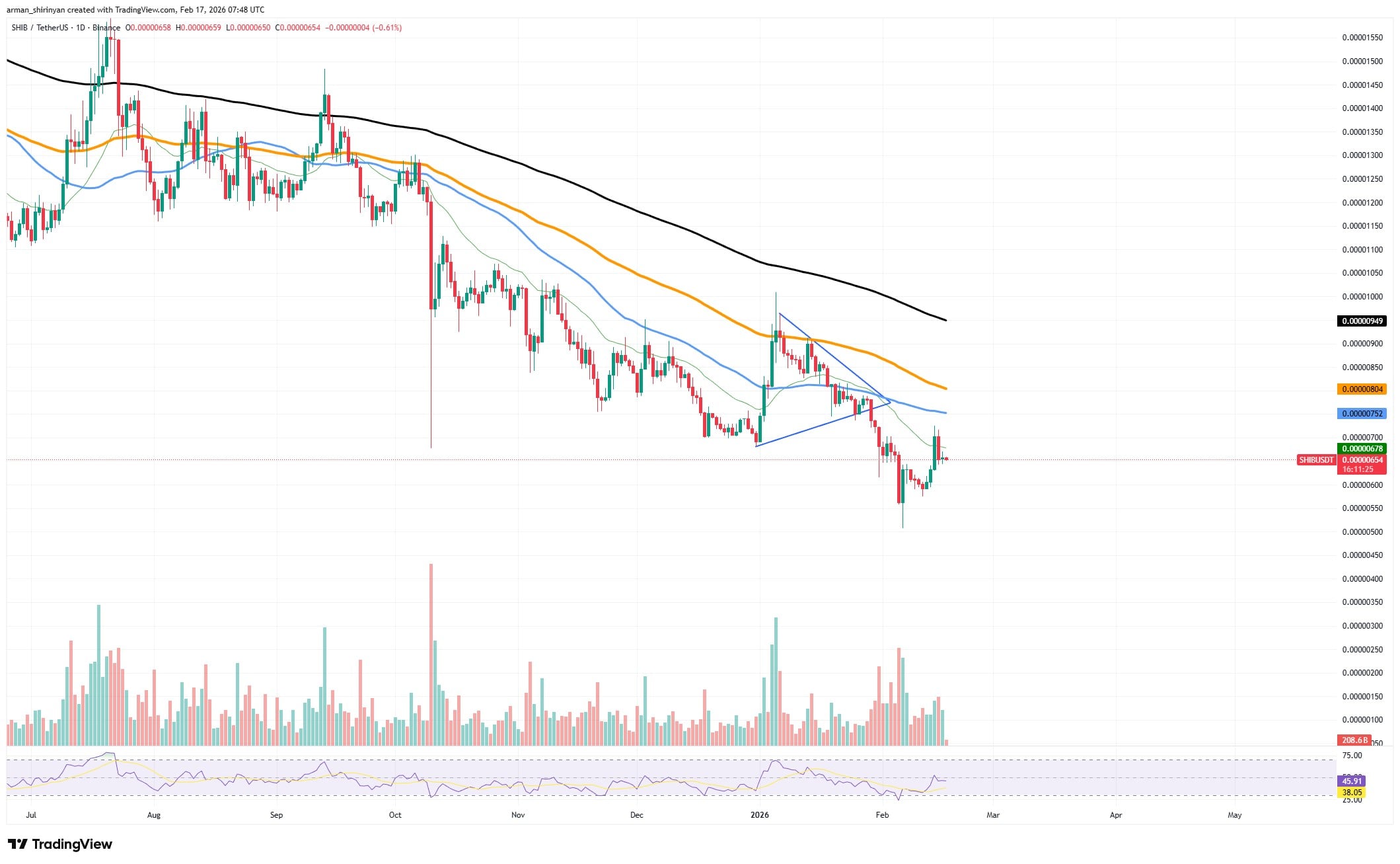
Zooming out to the daily chart, recent attempts at stabilization have not been able to relieve the pressure on the larger structure. SHIB’s price continues to move below moving averages, despite months of printing a series of lower highs and lower lows. Despite recovering from oversold conditions, the asset has not yet broken the pattern that characterizes the current downward trend.
You Might Also Like

Though there is not enough data to confirm a proper trend reversal just yet, daily momentum indicators are gradually recovering, indicating that selling pressure is lessening. In order to improve recovery prospects, SHIB would need to establish higher support levels and regain important daily moving averages, neither of which has happened yet.
Traders should keep a careful eye on SHIB’s behavior in the near term around the four-hour chart’s 200-EMA. If a confirmed breakout occurs above this level, the token may be able to extend its recovery and target higher resistance zones. On the other hand, persistent rejection would probably encourage prudence and maintain downside risks.