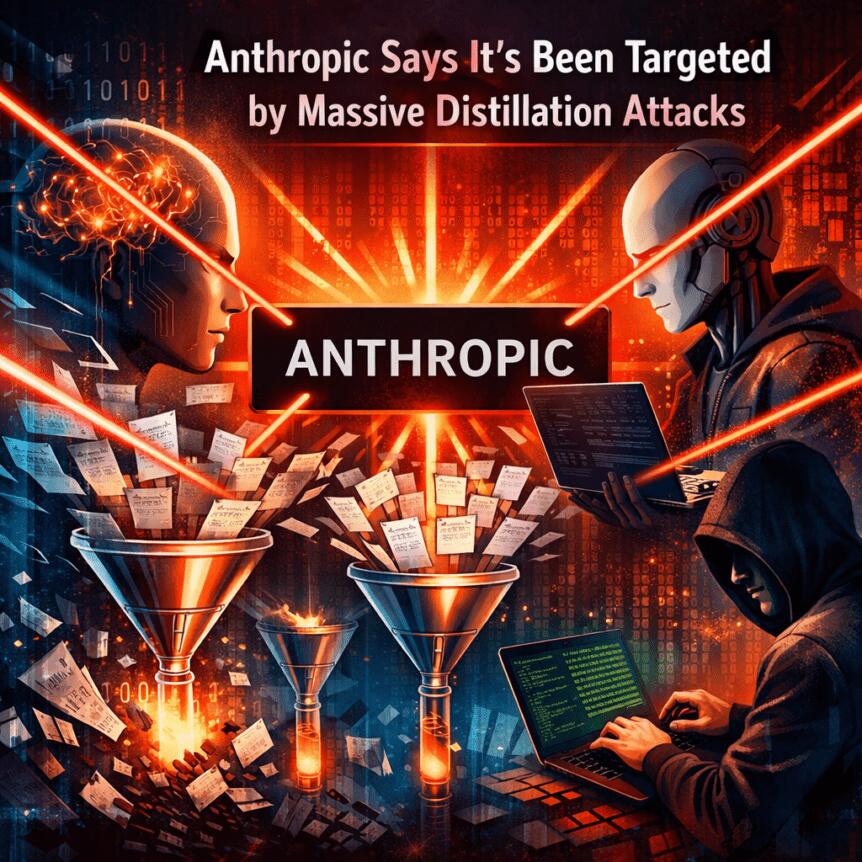
Frontier AI developer Anthropic has publicly accused three Chinese AI labs—DeepSeek, Moonshot, and Minimax—of conducting distillation attacks aimed at siphoning capabilities from Claude, Anthropic’s large language model. In a detailed blog post, the company describes campaigns that allegedly produced over 16 million exchanges across roughly 24,000 fraudulent accounts, exploiting Claude’s outputs to train less capable models. Distillation, a recognized training tactic in AI, becomes problematic when deployed at scale to replicate powerful features without bearing the same development costs. Anthropic emphasizes that while distillation has legitimate uses, it can enable rival firms to shortcut breakthroughs and uplift their own products at a fraction of the time and expense.
Key takeaways
- Distillation involves training a weaker model on the outputs of a stronger one, a method widely used for creating smaller, cheaper versions of AI systems.
- Anthropic alleges that DeepSeek, Moonshot, and Minimax orchestrated mass-scale distillation campaigns, generating millions of interactions with Claude across tens of thousands of fake accounts.
- The attacks reportedly targeted Claude’s differentiated capabilities, including agentic reasoning, tool use, and coding, signaling a focus on high-value, transferable competencies.
- The firm argues that foreign distillation campaigns carry geopolitical risks, potentially arming authoritarian actors with advanced capabilities for cyber operations, disinformation, and surveillance.
- Anthropic says it will bolster detection, share threat intelligence, and tighten access controls, while urging broader industry cooperation and regulatory engagement to counter these threats.
Market context: The incident arrives amid heightened scrutiny of AI model interoperability and the security of cloud-based AI offerings, a backdrop that also touches on automated systems used in crypto markets and related risk-management tools. As AI models become more embedded in trading, risk assessment, and decision-support, ensuring the integrity of input data and model outputs grows ever more important for both developers and users in the crypto space.
Why it matters
The allegations underscore a tension at the heart of frontier AI: the line between legitimate model distillation and exploitative replication. Distillation is a common, legitimate practice used by labs to deliver leaner variants of a model for customers with modest compute budgets. Yet, when leveraged at scale against a single ecosystem, the technique can be co-opted to extract capabilities that would otherwise require substantial research and engineering. If confirmed, the campaigns could prompt a broader rethink of how access to powerful models is controlled, monitored, and audited, particularly for firms with global reach and complex cloud footprints.
Anthropic asserts that the three named firms carried out activities designed to harvest Claude’s advanced abilities through a combination of IP-address correlation, request metadata, and infrastructure indicators, with independent corroboration from industry partners. This signals a concerted, data-driven effort to map and replicate cloud-based AI capabilities, not merely isolated experiments. The scale described—tens of millions of interactions across thousands of accounts—raises questions about the defense measures in place to detect and disrupt such patterns, as well as the accountability frameworks that govern foreign competitors operating in AI spaces with direct national and economic implications.
“Distillation is a widely used and legitimate training method. For example, frontier AI labs routinely distill their own models to create smaller, cheaper versions for their customers,” Anthropic wrote, adding:
“But distillation can also be used for illicit purposes: competitors can use it to acquire powerful capabilities from other labs in a fraction of the time, and at a fraction of the cost, that it would take to develop them independently.”
Beyond the IP concern, Anthropic ties the alleged activity to strategic risk for national security, arguing that distillation attacks by foreign labs could feed into military, intelligence, and surveillance systems. The company contends that unprotected capabilities could enable offensive cyber operations, disinformation campaigns, and mass surveillance, complicating the geopolitical calculus for policymakers and industry players alike. The assertion frames the issue as not merely a competitive dispute but one with broad implications for how frontier AI technologies are safeguarded and governed.
In outlining a path forward, Anthropic says it will enhance detection systems to spot dubious traffic patterns, accelerate threat-intelligence sharing, and tighten access controls. The company also calls on domestic players and lawmakers to collaborate more closely in defending against foreign distillation actors, arguing that a coordinated, industry-wide response is essential to curb these activities at scale.
For readers tracking the AI policy frontier, the allegations echo ongoing debates about how to balance innovation with safeguards—issues that are already echoing through discussions about governance, export controls, and cross-border data flows. The broader industry has long grappled with how to deter illicit use without stifling legitimate experimentation, a tension that will likely be a focal point for future regulatory and standards-setting efforts.
What to watch next
- Anthropic and the accused firms may publish further details or clarifications about the allegations and their respective responses.
- Threat intelligence bodies and cloud providers could release updated indicators of compromise or defensive guidance related to distillation-style attacks.
- Regulators and lawmakers may issue or refine policies governing AI model access, cross-border data sharing, and anti-piracy measures for high-capability models.
- Independent researchers and security firms may replicate or challenge the methodologies used to identify the alleged campaigns, potentially expanding the evidence base.
- Industry collaborations could emerge to establish best practices for protecting frontier model capabilities and for auditing model distillation processes.
Sources & verification
- Anthropic blog post: Detecting and Preventing Distillation Attacks — official statement detailing the accusations and the described campaigns.
- Anthropic’s X status post referenced in the disclosure — contemporaneous public record of the company’s findings.
- Cointelegraph coverage and linked materials discussing AI agents, frontier AI, and related security concerns referenced in the article.
- Related discussions on the role of distillation in AI training and its potential misuse in competitive environments.
Distillation attacks and frontier AI security
The core claim rests on a structured abuse of distillation, wherein a stronger model’s outputs—Claude in this case—are used to train alternative models that mimic or approximate its capabilities. Anthropic contends this is not a minor leak but a sustained campaign across millions of interactions, enabling the three firms to approximate high-end decision-making, tool use, and coding abilities without bearing the full cost of original research. The numbers cited—more than 16 million exchanges across approximately 24,000 fraudulent accounts—illustrate a scale that could destabilize expectations about model performance, customer experience, and data integrity for users relying on Claude-based services.
What the allegations imply for users and builders
For practitioners building on AI, the case underscores the importance of robust provenance, access controls, and continuous monitoring of model usage. If foreign distillation can be scaled to produce viable stand-ins for leading capabilities, then the door opens to widespread commoditization of powerful features that were previously the result of substantial investment. The consequences could extend beyond IP loss to include drift in model behavior, unexpected tool integration failures, or the propagation of subtly altered outputs to end users. Builders and operators of AI-enabled services—whether in finance, healthcare, or consumer tech—may respond with heightened scrutiny of third-party integrations, stricter licensing terms, and enhanced anomaly-detection around API traffic and model queries.
Key considerations for the crypto ecosystem
While the incident centers on AI model security, its resonance for crypto markets lies in how automated decision-support, trading bots, and risk assessment tools depend on reliable AI inputs. Market participants and developers should remain vigilant about the integrity of AI-enabled services and the potential for compromised or replicated capabilities to influence automated systems. The situation also highlights the broader need for cross-industry collaboration on threat intelligence, standards for model provenance, and shared best practices that can help prevent a spillover of AI vulnerabilities into financial technologies and digital asset platforms.
What to monitor in the near term
- Public updates from Anthropic on findings, indicators of compromise, and any remediation milestones.
- Clarifications or statements from DeepSeek, Moonshot, and Minimax regarding the allegations.
- New guidelines or enforcement actions from policymakers aimed at foreign distillation and export controls for AI capabilities.
- Enhanced monitoring tools and access-control strategies adopted by cloud providers hosting frontier AI models.
- Independent research validating or contesting the methods used to detect distillation patterns and the scale of the claimed activity.