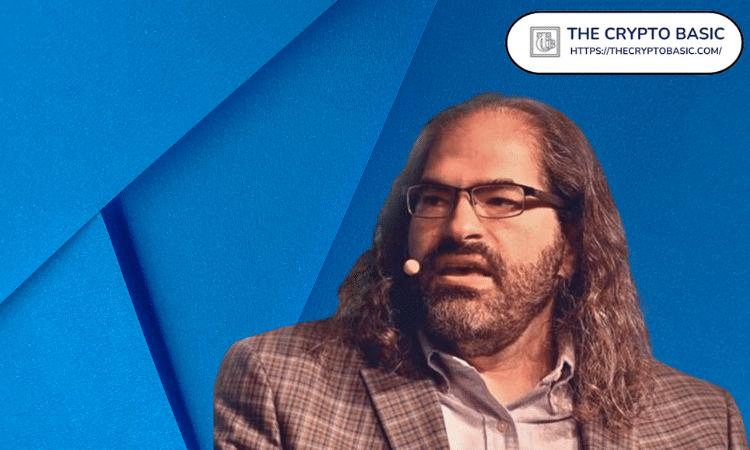
Ripple CTO Emeritus David Schwartz has rejected claims that the XRP Ledger (XRPL) operates as a centralized network under Ripple’s control.
His response followed a public exchange with Justin Bons, founder and CIO of Cyber Capital, reigniting debate around decentralization in blockchain networks.
While Bons accused Ripple and several other platforms of operating centralized systems, Schwartz rejected the allegations, calling them technically flawed and misleading.
Key Points
- Ripple CTO Emeritus David Schwartz rejects claims that the XRPL operates as a centralized network under Ripple’s control.
- He argues that XRPL and the Bitcoin network do not share the same vulnerabilities.
- Schwartz stresses that transaction discrimination occurs only on Bitcoin and Ethereum, not on XRPL.
- Schwartz has continued to defend XRPL’s decentralization, including dismissing criticisms from Custodia Bank CEO Caitlin Long.
Bons Accuses XRPL and Other Networks of Centralization
The debate began when Justin Bons urged crypto users to reject all blockchains he considers centralized, specifically naming XRPL (which he called Ripple).
Other mentioned networks include Stellar, Canton, Algorand, and Hedera, with Bons claiming they fail to meet decentralization standards. Specifically, Bons criticized XRPL’s Unique Node List (UNL) mechanism, claiming it grants Ripple “absolute power and control” over network consensus.
According to him, validators effectively need permission to participate, and deviating from the recommended list could lead to network forks.
Schwartz Refutes Claim
In response, David Schwartz dismissed the assertion, calling it “objectively nonsensical” and fundamentally inaccurate. He argued that the claim is akin to suggesting that a miner controlling the majority of hash power on Bitcoin could mint billions of BTC out of thin air.
In reality, even dominant miners cannot violate Bitcoin’s protocol rules without broader network agreement. Through this analogy, Schwartz suggested that influence does not equate to control.
He emphasized that the XRP Ledger operates through distributed validators and a consensus mechanism, not unilateral corporate authority from Ripple.
XRPL’s Model Differs Fundamentally From Bitcoin’s
As the exchange continued, Bons suggested that XRPL and Bitcoin share similar vulnerabilities. He argued that a coordinated validator majority on XRPL could theoretically censor transactions or execute double-spends, similar to a 51% attack on Bitcoin.
However, Schwartz rejected the comparison, stressing that XRPL’s consensus model fundamentally differs from Bitcoin’s proof-of-work system. He explained that XRPL nodes independently verify transactions and will not accept double-spends or censorship unless explicitly configured to do so.
If any validator behaves maliciously, honest nodes simply ignore its votes. Even in a coordinated attack, Schwartz noted that the worst possible outcome would be a temporary network halt, not fraudulent transaction approvals.
In such a scenario, users could quickly restore operations by selecting a new UNL, similar to how Bitcoin would require broad coordination to recover from compromised mining dominance.
Validators could conspire to halt the chain from the point of view of honest nodes. But that’s the XRPL equivalent of a dishonest majority attack except they never get to double spend. The cure is to pick a new UNL just as with BTC you’d need to pick a new mining algorithm.
— David ‘JoelKatz’ Schwartz (@JoelKatz) February 24, 2026
XRPL Avoids Transaction Discrimination
Schwartz also pointed out a key operational difference between Bitcoin and XRPL, focusing on transaction discrimination.
He argued that miners and validators on Bitcoin and Ethereum frequently reorder, delay, or prioritize transactions. In contrast, he said there is no confirmed case of malicious censorship or reordering of XRPL transactions.
“Nothing like this has ever happened to an XRPL transaction, and it’s hard to imagine how it could,” Schwartz said.
Ongoing Debate Over XRPL Centralization
Schwartz has built a reputation within the XRP community for consistently defending XRPL’s decentralization.
Critics often point to Ripple’s large XRP holdings as evidence of centralization, while Bons emphasizes the UNL system as proof of structural control.
However, Schwartz has repeatedly pushed back. In past remarks addressing Caitlin Long, he stressed that XRPL is not centralized and noted that the network operates with more than 1,000 independent nodes.
Regarding Ripple’s XRP holdings, Schwartz emphasized that there is no evidence the company would use its reserves, much of which remains locked in escrow, to harm retail participants.
Moreover, market data shows that Ripple’s escrow releases have not historically triggered bearish price reactions. Instead, XRP’s price movements largely track broader crypto market trends rather than Ripple’s distribution.
DisClamier: This content is informational and should not be considered financial advice. The views expressed in this article may include the author’s personal opinions and do not reflect The Crypto Basic opinion. Readers are encouraged to do thorough research before making any investment decisions. The Crypto Basic is not responsible for any financial losses.