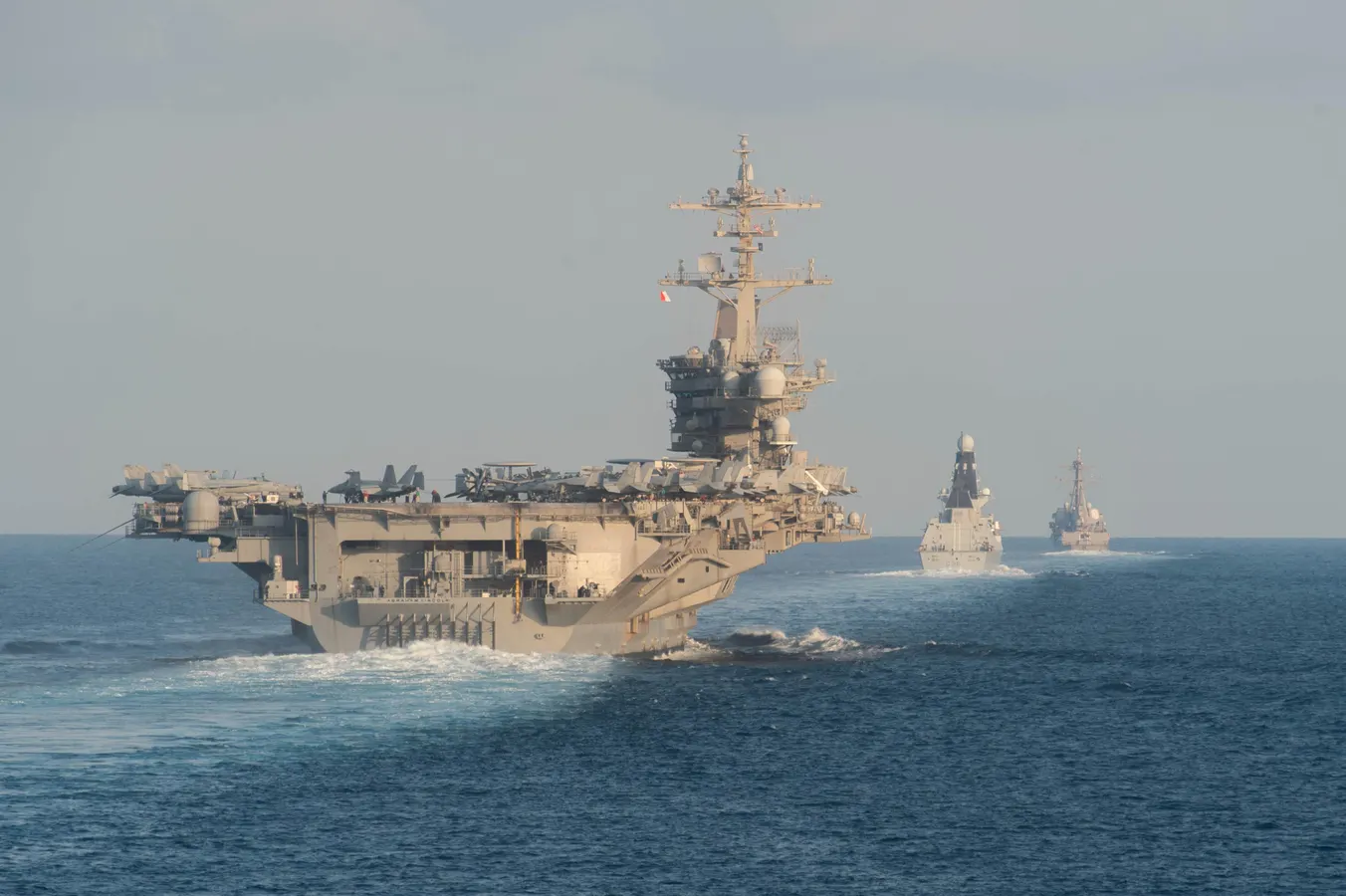

STRAIT OF HORMUZ – NOVEMBER 19: In this handout photo provided by the US Navy, The aircraft carrier USS Abraham Lincoln (CVN 72), left, the Royal Navy air defense destroyer HMS Defender (D 36) and the guided-missile destroyer USS Farragut (DDG 99) transit the Strait of Hormuz on November 19, 2019. The Abraham Lincoln Carrier Strike Group is deployed to the U.S. 5th Fleet area of operations in support of naval operations to ensure maritime stability and security in the Central Region, connecting the Mediterranean and the Pacific through the western Indian Ocean and three strategic choke points. With Abraham Lincoln as the flagship, deployed strike group assets include staffs, ships and aircraft of Carrier Strike Group (CSG) 12, Destroyer Squadron (DESRON) 2, the guided-missile cruiser USS Leyte Gulf (CG 55) and Carrier Air Wing (CVW) 7. (Photo by Zachary Pearson- U.S. Navy via Getty Images)
U.S. Navy
Amid the myriad uncertainties created by the new conflict in the Middle East region, the one thing we can be sure of is that gasoline prices at the pump will go up in the United States and around the world. The only real questions in that regard are: How high will they go, and how long will they linger?
The first thing to say is that, as of this writing early on the morning of February 28, there is no reason for any U.S. driver to panic. However, prices at the pump will start rising almost immediately as new deliveries from refineries roll into your local gas stations.
Gasoline Prices Going Up
As I’ve pointed out here many times in the past, gas prices tend to rise and fall in conjunction with increases and decreases in the global price for crude oil. The direction of those prices set on a global trading market depends on a wide variety of factors related to supply and demand.
However, in this current conflict in which the United States and Israel are involved in a kinetic exchange with Iran, a single factor holds the key. That single factor is the Strait of Hormuz, the choke point at the mouth of the Persian Gulf through which 20-25% of global crude supply flows onto the global market every day, and whether Iran might mount a successful attack to shut that flow down. This is a threat Iran’s leaders have repeatedly made whenever threatened in the past.
EIA Chart depicting crude oil flows through the Strait of Hormuz.
U.S. Energy Information Administration
The Strait is currently under the protection of the U.S. Navy’s U.S.S. Abraham Lincoln carrier group, which is stationed off the coast of the Arabian Peninsula as of now. Thus, Iran would have to inflict severe damage on that carrier group and defeat other sizable U.S. Naval assets in the Persian Gulf proper to have any such success.
This seems unlikely, but the threat does exist. Since crude is traded on a speculative market, the mere threat will result in at least a modest increase in crude prices which will flow into the price of gas at the pump. A full shutdown of the Strait would without doubt cause crude prices to skyrocket from current levels, possibly to more than $100 per barrel, in short order.
LNG Flows Also Threatened
The threat applies to more than just crude oil. Tankers carrying roughly 20-22% of global supplies of liquefied natural gas (LNG) also must make their way through the Strait of Hormuz each day, as well. Many countries in Europe, Asia and others around the world have come to rely on LNG to support power grids, home heating, and industrial needs in recent years.
EIA Illustration of LNG flows through the Strait of Hormuz.
U.S. Energy Information Administration
Any shutdown of the Strait would result in a spike in prices for global LNG shipments which would not only raise costs to governments and consumers in international markets, but would also likely force U.S. domestic natural gas prices upwards due to spiking demand for U.S. LNG.
It all means that U.S. consumers should prepare for rising gasoline prices and other energy costs in the days and possibly weeks to come. The status of the Strait of Hormuz will determine how high those prices will go and how long they will linger.