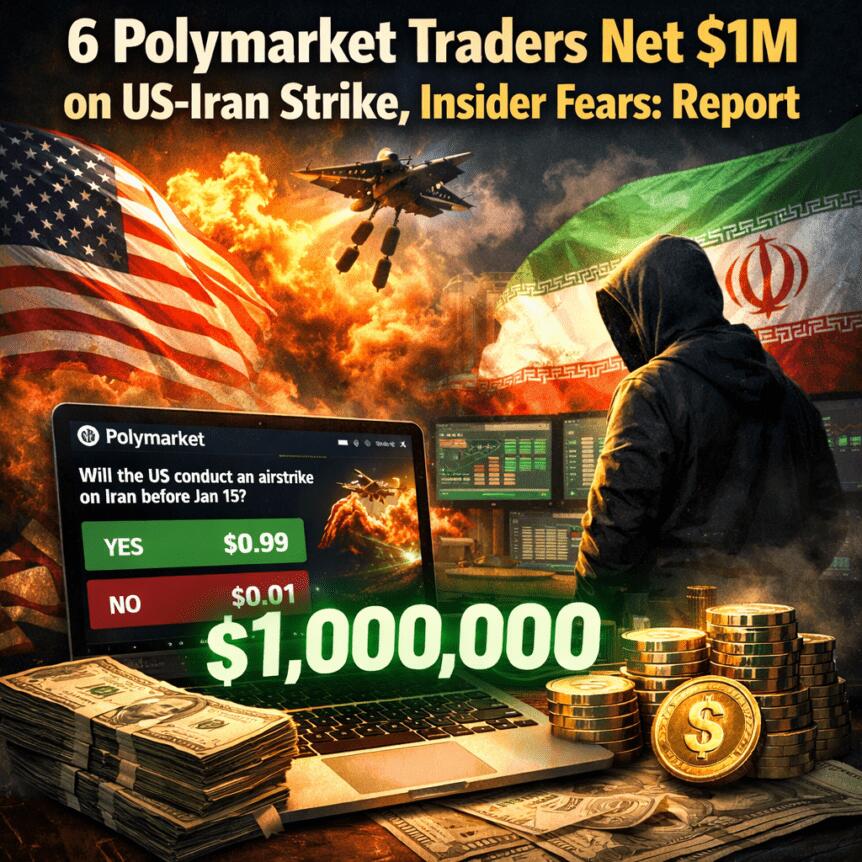
Six Polymarket traders earned roughly $1 million after accurately predicting that the United States would strike Iran before February ended, triggering insider trading concerns on the platform. The six wallets all appeared in February and placed the bulk of their activity on contracts forecasting the timing of a potential U.S. attack, a pattern highlighted by data analytics firm Bubblemaps SA and reported by Bloomberg. In several instances, these bets were opened just hours before explosions were first reported in Tehran, with some contracts purchased for around $0.10 per unit.
On-chain investigators have begun to flag the clustering of new wallets and the rapid-fire timing as reminiscent of insider activity observed in other prediction-market episodes. While such activity is not proof of wrongdoing, it has intensified scrutiny of how information flows can influence decisions on platforms like Polymarket. Attempts to obtain comment from Polymarket prior to publication were not successful.
During the broader escalation, more than $529 million flowed into Polymarket’s strike-related contracts, underscoring the platform’s role as a liquidity vector during geopolitical spikes. The February 28 contract drew roughly $90 million in trading volume, making it the most active date among traders, while an earlier January 31 scenario accounted for roughly $42 million.
It’s important to note that one flagged account had previously lost money on an earlier prediction before placing a larger wager that later yielded more than $170,000, illustrating that a single pattern does not conclusively indicate manipulation. Washington had signaled possible military action for weeks, a backdrop that likely contributed to speculative activity on the platform.
Beyond the Iran-focused bets, Polymarket has faced regulatory scrutiny across multiple jurisdictions. Authorities in the Netherlands, Hungary, Belgium, France, Italy, Romania, Poland, Singapore, and Portugal have moved to block or ban the platform, classifying its event-based contracts as unlicensed online gambling rather than financial trading. The evolving regulatory environment adds a layer of uncertainty for users seeking to trade events tied to real-world outcomes.
The broader insider-trading conversation around Polymarket is not limited to Iran. This week, a cluster of crypto wallets earned more than $1.2 million betting on a contract tied to an on-chain investigation into the Axiom DeFi project, following claims by ZachXBT that an Axiom employee and associates had engaged in insider trading since early 2025. Earlier coverage highlighted a separate Polymarket bet linked to the capture of Venezuelan President Nicolás Maduro, where a single wallet reportedly netted about $400,000 after placing bets moments before the news broke. These examples collectively illustrate the tension between market-discovery dynamics and the potential for information asymmetry to influence outcomes on prediction markets.
As the sector contends with these episodes, lawmakers are not standing still. A bill proposed by U.S. Representative Ritchie Torres, the Public Integrity in Financial Prediction Markets Act of 2026, aims to curb insider trading on prediction platforms by restricting trading for officials or other individuals who possess nonpublic information related to government policy or political outcomes. The proposal underscores a broader push to align digital prediction markets with traditional securities and gambling regulations, a topic that has gained attention amid a wave of enforcement and licensing actions around the world.
Polymarket Iran strike bets draw $529 million in volume
During the height of the Iran-related escalation, Polymarket saw more than $529 million in flow across its strike contracts. The most active line was the February 28 event, which attracted about $90 million in trading activity, indicating a strong appetite for event-driven bets during periods of geopolitical risk. A separate late-January scenario still drew tens of millions in volume, demonstrating sustained interest in predicting real-world outcomes as tensions evolved.
While observers caution that correlation does not equal causation, the clustering of new wallets around sensitive geopolitical bets raises questions about how nonpublic information and timing can influence on-chain markets. Investigators have stressed that the existence of a profitable trade in itself is not sufficient evidence of illicit activity; however, patterns that mimic prior insider-trading signals merit careful examination by platform operators and regulators alike.
The Merits and Limits of Prediction Markets
Polymarket’s experience occurs within a broader ecosystem of event-based markets that promise rapid, real-time pricing of outcomes ranging from geopolitics to sports. Critics argue that the very design—where users can trade on ever-narrow event windows—makes these platforms susceptible to information advantage and potential manipulation. Proponents counter that prediction markets can aggregate dispersed information and provide useful signals for participants. The tension between innovation and oversight remains a defining dilemma for the crypto-driven prediction space.
The ongoing regulatory dragnet adds layers of complexity. As Polymarket has faced bans in multiple jurisdictions, users and developers alike are watching how licensing regimes will evolve. The enforcement posture in Europe, North America, and parts of Asia will likely influence the pace at which such markets expand or contract, depending on how regulators classify event-based contracts and whether they require traditional financial-license frameworks, gambling licenses, or a hybrid approach.
Meanwhile, the ecosystem continues to document and debate incidents of suspected insider activity. The cases tied to Axiom and Maduro, alongside the Iran-related bets, are shaping a narrative about information flow, anonymity, and risk management in on-chain markets. For participants, this translates into heightened due diligence, stricter privacy controls, and more rigorous withdrawal and settlement procedures as platforms navigate evolving compliance requirements.
The Iran episode also prompts a closer look at the broader market consequences. Liquidity surges around high-stakes news events can amplify price discovery but may also increase the risk of mispricing if information leaks influence trading behavior ahead of public disclosures. In this context, regulators and platform operators face the challenge of balancing transparency, user protection, and the fundamental promise of decentralized event markets to reflect real-world developments in near real time.
As the sector moves forward, market participants should monitor regulatory developments, platform policy changes, and ongoing investigative efforts that could shape how prediction markets operate in the coming months. The core takeaway is not merely about a single trade but about how a burgeoning asset class negotiates governance, legality, and the integrity of information in a rapidly evolving financial landscape.
Why it matters
The episode highlights the rising prominence of prediction markets within the crypto ecosystem and the ongoing debates about their governance and legitimacy. For traders, the events emphasize the dual nature of these platforms: they can surface timely information and provide hedging opportunities, yet they also expose participants to regulatory risk and the potential for nonpublic information to influence outcomes. For platform operators, the incidents underscore the need to implement robust identity and telemetry controls, transparent policy guidelines, and clear responses to investigations and licensing inquiries.
From a policy perspective, the convergence of digital markets and geopolitical risk invites a rethinking of how prediction markets should be regulated. The proposed Public Integrity in Financial Prediction Markets Act signals a willingness among some lawmakers to extend traditional oversight concepts into the crypto space, seeking to curb unfair trading practices while preserving the mechanism’s information-rich pricing signal. Regulators will weigh how to balance consumer protection with innovation, a difficult but essential task as markets continue to evolve.
For builders and researchers, the episodes underscore the importance of on-chain analytics in monitoring activity, identifying suspicious patterns, and improving risk controls without stifling innovation. The dialogue between auditors, policymakers, and platform operators will shape the design space for next-generation prediction markets, potentially driving smarter wallet onboarding, better market design, and more robust dispute resolution mechanisms.
What to watch next
- Regulatory responses to Polymarket and other prediction markets, including potential licensing requirements and enforcement actions.
- Official statements from Polymarket regarding the insider-trading allegations and steps to strengthen market integrity.
- Updates on U.S. legislative proposals, such as the Public Integrity in Financial Prediction Markets Act of 2026, and their path through congressional committees.
- Ongoing investigations into Axiom-related insider trading and any resulting policy or enforcement implications for similar platforms.
- forthcoming analyses from on-chain analytics firms and independent researchers detailing patterns in high-volume geopolitical bets.
Sources & verification
- Bloomberg reporting on six February-created Polymarket wallets and the $1 million profit, citing Bubblemaps SA data: https://www.bloomberg.com/news/articles/2026-02-28/polymarket-iran-bets-hit-529-million-as-new-wallets-draw-notice
- Polymarket event page for the Iran strike contracts: https://polymarket.com/event/us-strikes-iran-by
- U.S. Representative Ritchie Torres’ proposed anti-insider trading bill for prediction markets (coverage and references): https://cointelegraph.com/news/ritchie-torres-prediction-markets-insider-trading-bill-maduro-bet
- Related insider-trading discussions on Polymarket involving ZachXBT and Axiom: https://cointelegraph.com/news/suspected-insider-1-2m-zachxbt-axiom-expose
- Earlier Maduro bet coverage on Polymarket: https://cointelegraph.com/news/polymarket-user-who-won-400k-on-maduro-bet-quietly-disappears