Bitcoin has continued to face a severe price correction as its price fails to reclaim levels seen earlier in the year.
Amid the prolonged price correction, the asset has continued to approach critical levels, with most investors who purchased BTC within the last two years now sitting at a loss.
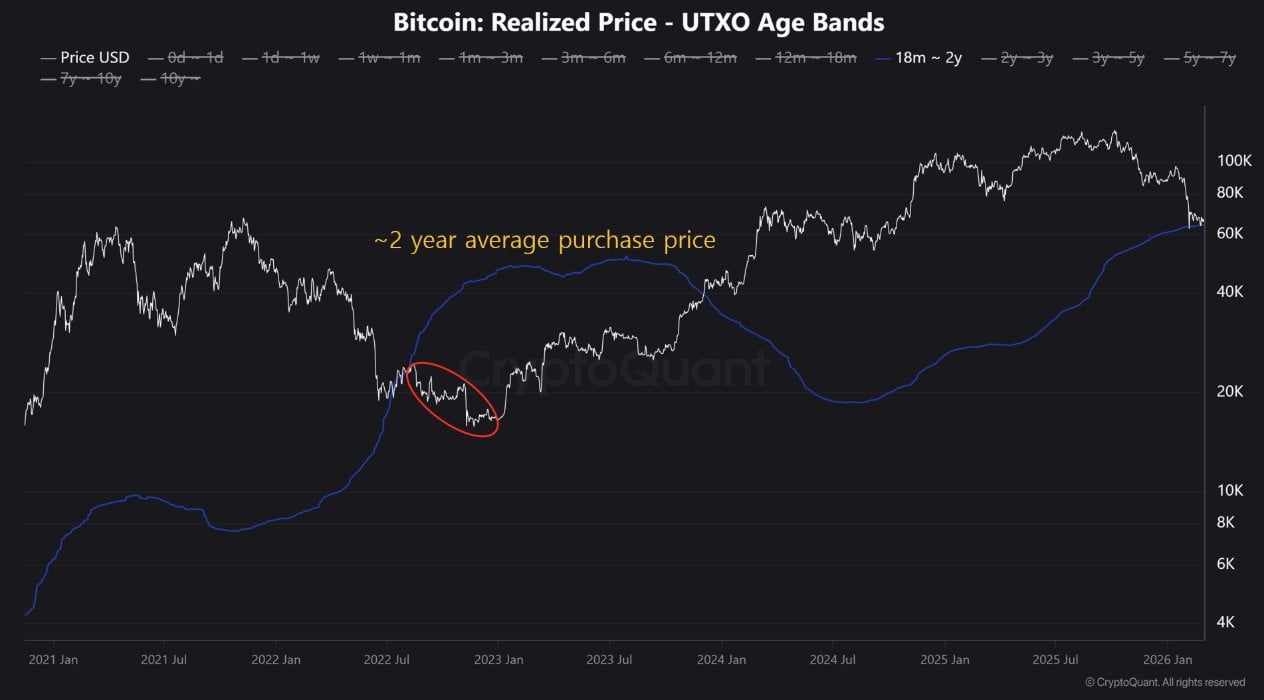
A recent analysis provided by crypto analytics platform CryptoQuant shows that as the Bitcoin price hovers near the $60,000 region, the average cost basis of Bitcoin investors holding the asset for 18-month to 2-year holders is being tested.
Bitcoin on verge of major reset
With Bitcoin’s two-year-old buyers now underwater, the asset is now at a level that has historically marked major turning points in historic market cycles.
The prolonged market volatility has weakened Bitcoin’s price action, pushing a large portion of midterm holders into negative territory while shifting overall sentiment from cautious optimism to extreme doubt.
You Might Also Like

While the majority of Bitcoin holders are in losses, it has been observed that major corrections tend to intensify when the majority of participants are in profit. This often leads to further price pullbacks.
On the other hand, strong rallies have often begun when losses become widespread and market confidence is shaken, as seen currently. This means that the massive losses unrealized by Bitcoin holders could precede a major price recovery.
Bitcoin’s long-term holders still in profit
Nonetheless, it is important to note that long-term holders who accumulated years ago are still in profit, despite the prolonged market volatility that has kept Bitcoin in red over the past few months.
However, recent buyers, especially those who bought during the later stages of the last rally, are now facing mounting unrealized losses.
These recent buyers could face bigger losses If Bitcoin decisively drops below $60,000. The positive side is that it could be a potential opportunity for a possible “reset,” phase where excessive optimism is completely eliminated and creates a chance for a healthier environment that could fuel a sustainable recovery.