

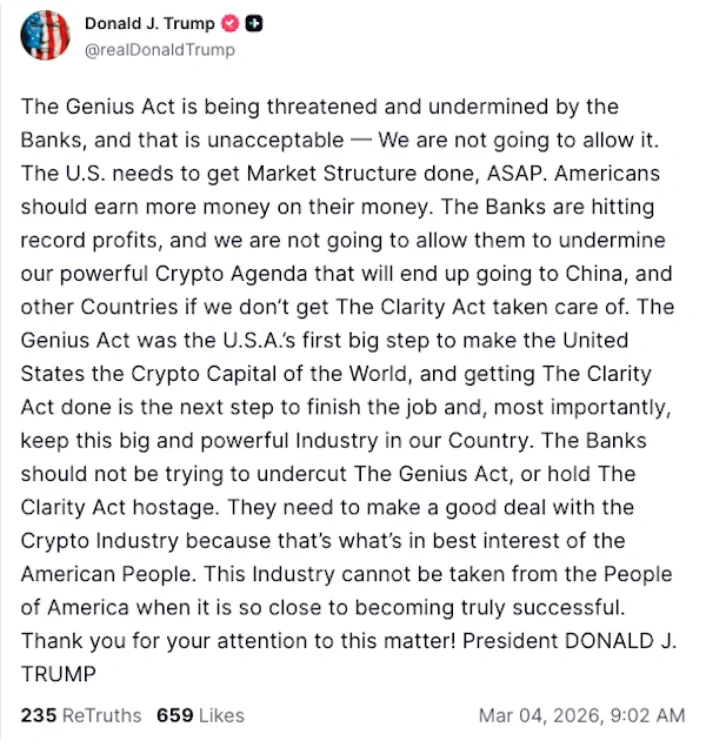
The battle for cryptocurrency control has become the primary issue for Washington D.C. The US President Donald Trump accused major banks of attempting to block a Senate bill which would determine the future of digital assets. The dispute centers on the proper regulation of stablecoins and their ability to generate interest for users.
Through Truth Social Trump defended the GENIUS Act which became law in July to establish regulations for stablecoins. He warned that banks will block essential market structure development efforts. He presented cryptocurrency as a national issue because he believed that any delays would allow other countries to overtake American innovation.
Also Read: XRP Steadies Near $1.39 as Clarity Act Optimism Builds
Cryptocurrency and Stablecoin Yield Battle
The GENIUS Act provides stablecoin issuers with a definite procedure for establishing regulatory compliance. The act defines stablecoins as payment instruments which operate on blockchain systems and exclude investment classification. The rules prohibit issuers from providing direct yield benefits to their token holders.
The situation contains an unexpected development. Third-party platforms, such as exchanges, can still provide yield on stablecoin holdings. Banking groups say this creates a loophole. They want the Senate’s market structure bill to ban all stablecoin yield payments.
Banks assert that permit yield expressions would result in deposit outflow from standard banking accounts. Users who transfer their money to cryptocurrency platforms for superior returns will create a capital loss for banks. They issue warnings about potential threats which endanger financial system stability.
Crypto companies contest the situation. In January, Coinbase stopped backing the Senate bill because its proponents attempted to establish a complete yield prohibition. The Senate Banking Committee then postponed markup of the legislation. The negotiations have not progressed since that time.
Cryptocurrency Politics and CLARITY Act
The House has already passed its own version of the bill, known as the CLARITY Act. The House Financial Services Committee chair Representative French Hill asked the Senate to accept House language when the two bodies fail to find common ground. He noted that the bill passed with bipartisan backing, including 78 Democratic votes.
Crypto and banking groups have conducted three meetings at the White House during this calendar year. No compromise has emerged.
With midterm elections approaching in November, cryptocurrency has become more than policy. The situation has evolved into a political battle where power and profit collide through one critical vote.
Also Read: Cryptocurrency Influencers to Disclose Assets: S.Korea Exclusively Mandates 2026 Regulations