

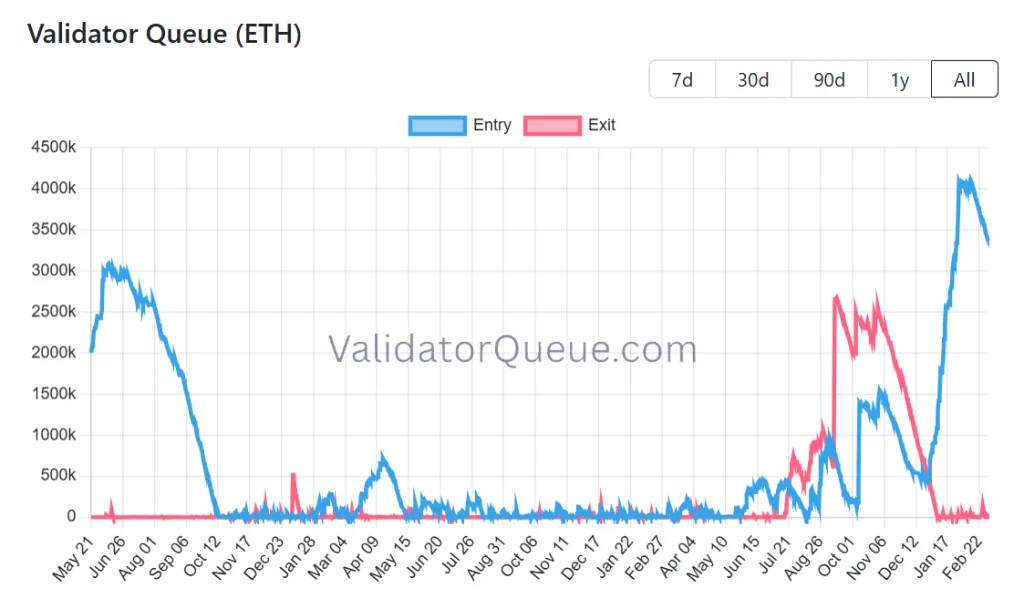
Ethereum’s validator queue is at its highest level ever recorded. Large investors, including corporates and exchanges, are opting to stake rather than sell in recent periods of market appreciation. This is a clear sign of a shift in long-term positioning on the Ethereum network.
The current queue includes approximately 3.4 million ETH, awaiting inclusion in the validator set. This queue is about 60 days long, according to ValidatorQueue.com. This number has increased significantly since early January, when it was reported to be about 904,000 ETH.
The increase is a sign of increasing interest in staking among large investors. These investors seem to be more interested in yield generation than trading. Analysts believe this is a sign of caution among investors who want to remain stable in uncertain market cycles.
Source: ValidatorQueue.com
Ethereum Queue Signals Long-Term Investor Shift
Pav Hundal, lead analyst at Swyftx, highlighted the signal behind the trend. He said, “This is important because it indicates that there is an entry queue, and it is showing long-term investors are locking up supply for yield.”
Ethereum validators need 32 ETH for activation. New validators are added at a limited rate according to protocol rules. However, if interest is higher than what is available, validators are queued and delayed. These delays can take weeks and sometimes months.
The Pectra upgrade, which was implemented last year, changed the way large operators manage stakes. This upgrade allows them to consolidate larger amounts of stake into fewer validators. This adjustment makes scaling more efficient for firms holding significant reserves.
Also Read: Ethereum Network Activity Surges to 10-Year High As Price Struggles at $2K
Hundal also mentioned observations from industry contacts. He said that the present wave in staking is driven by corporates and exchanges seeking to generate yields from idle tokens. These participants are very focused on maximizing the performance of their assets.
Institutions Favor Staking for Low-Risk Yield
The increase in demand for staking is not rising in the same way as last year. The exit queue for validators increased significantly in 2025, peaking at around 2.7 million ETH. It has been falling steadily since then and is now around zero.
This indicates that capital is flowing back into Ethereum’s validator stack. The investors who exited in 2025 seem more inclined to return, especially in the present environment.
For institutions holding significant ETH, staking is a low-risk way to generate yields. It also allows them to remain exposed to the price action of Ethereum. This is helpful from a risk management and portfolio efficiency perspective.
Hundal said broader themes may support current interest in the asset. The narratives surrounding the potential use cases for Ethereum in payment systems and of the AI-related use cases seem to be gaining traction. He said these themes could strengthen market sentiment as the year progresses.
Also Read: Tether Expands Into Health Tech With $1.5 Billion Eight Sleep Strategic Investment