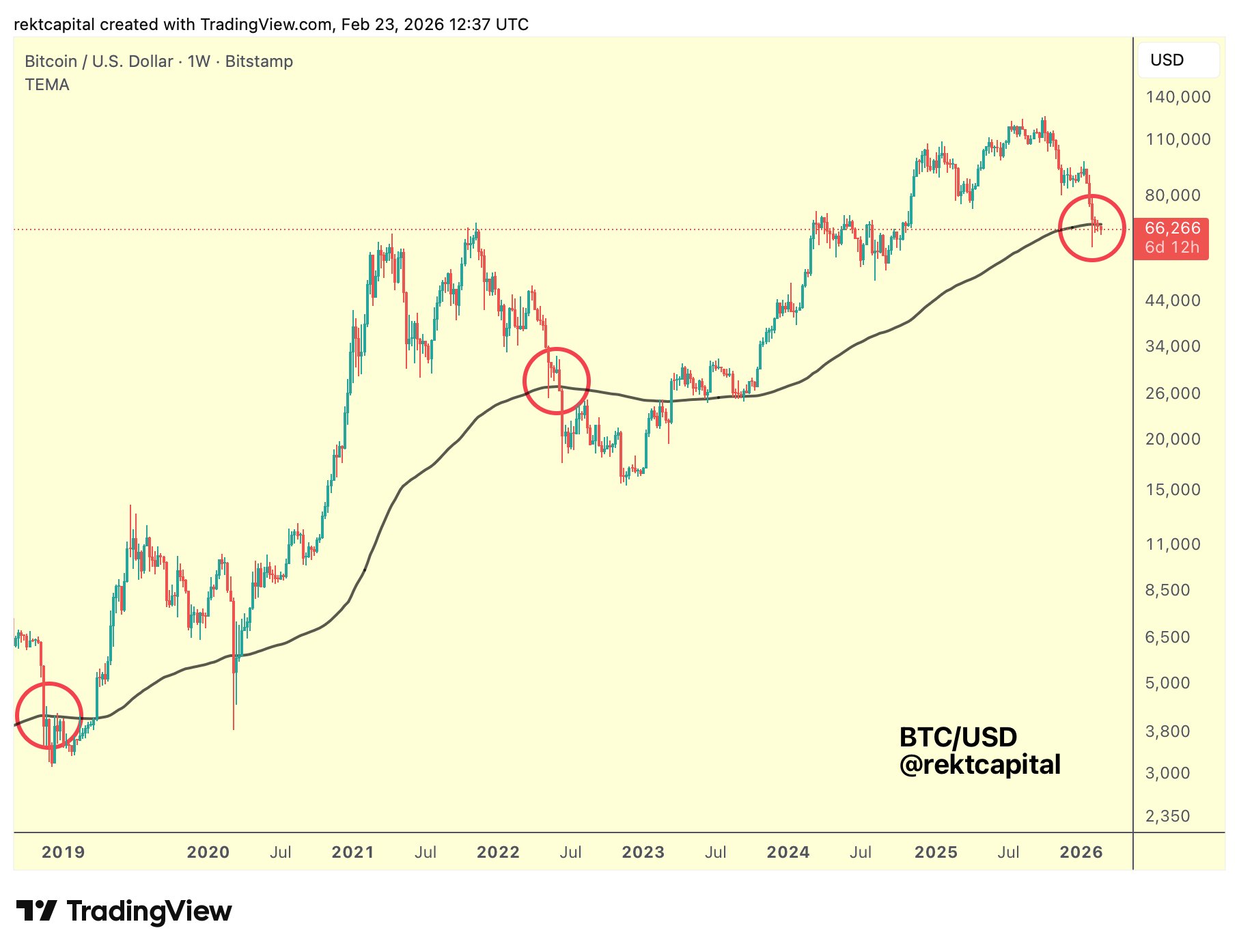
Bitcoin (BTC) closed a weekly candle below its 200-period exponential moving average (EMA) for the first time since October 2023. The weekly close ended a technical uptrend that lasted for 882 days.
The shift in trend renews focus on BTC’s onchain cost-basis levels and its historical interaction with the key moving average across previous cycles, framing a broader recovery timeline based on past market behavior.
The weekly trend may flip to resistance for Bitcoin
The 200-week EMA tracks Bitcoin’s long-term trend and has historically separated expansion phases from the deeper corrective periods. On the weekly chart, BTC closed below the average near $67,628, ending a support streak that began in late 2023.
Crypto analyst Rekt Capital noted the development, stating,
“This technically means that the EMA has been lost as support and that price could turn it into resistance on any upcoming recovery.”

Previous cycles show that reclaiming the 200-weekly EMA has required time. In 2018, Bitcoin traded below the level for roughly 14 weeks before regaining it.
During the Covid-led March 2020 liquidity shock, the recovery took about eight weeks. In 2022, BTC remained under the average for nearly 30 weeks. Across these instances, the average duration below the 200-weekly EMA was approximately 17 to 18 weeks.
Momentum indicators also reflect the cooling of longer-term investor participation. Last week, Bitcoin researcher Axel Adler Jr. noted that entity-adjusted liveliness peaked in December 2025 after BTC reached an all-time high near $126,000 in October.
Liveliness measures the ratio of coin days destroyed to coin days created, adjusted for the internal transfers. The metric has since declined below its 30-day and 90-day moving averages, while the 90-day remains above the 365-day at 0.02622. Similar rollovers in 2020 and 2022 preceded extended accumulation phases lasting one to two years.

A sustained decline in the liveliness metric typically signals reduced spending activity and slower capital rotation, conditions that may lengthen the time required for BTC to rebuild a position and reclaim the 200-weekly EMA.
Related: Tether flashes Bitcoin bottom signal: Can BTC stage another 100% rally?
BTC realized price bands outline the demand zone
Bitcoin’s realized price, near $55,000, reflects the average onchain cost basis of all coins. The shifted realized price, near $42,000, projects this metric forward and historically highlights the deeper value areas during drawdowns.

With BTC trading between the 200-weekly EMA and the realized price band cluster, the region has historically acted as a long-term accumulation zone since 2015. Prior cycles show consolidation periods of six to eight months around these levels before broader upside continuation.
A reclaim of the 200-weekly EMA restores the price above a key long-term trend threshold. Failure to do so maintains focus on the $55,000 realized price and the lower shifted band near $42,000 as potential areas of liquidity concentration.
Related: Bitcoin traders diverge over BTC price strength with $60K in sight
This article does not contain investment advice or recommendations. Every investment and trading move involves risk, and readers should conduct their own research when making a decision. While we strive to provide accurate and timely information, Cointelegraph does not guarantee the accuracy, completeness, or reliability of any information in this article. This article may contain forward-looking statements that are subject to risks and uncertainties. Cointelegraph will not be liable for any loss or damage arising from your reliance on this information.