

Bitcoin (BTC) is experiencing selling pressure from short-term holders after its recent upward movement, while another on-chain metric suggests that market risk appetite could be increasing.
CryptoQuant contributor Darkfost stated that short-term holders (STHs) have sent in excess of 27,000 BTC to exchanges in the last 24 hours. This represents one of the largest profit-taking spikes observed in the past couple of months.
Bitcoin Short-Term Holders Take Profits
Darkfost also noted that, at this time, the only short-term holders realizing profits are those who purchased the asset between the past week and month. The average realized price for these holders is approximately $68,000, providing them with a high chance to profit upon selling after BTC’s recent rebound.
Darkfost further stated that short-term holders are generally considered the most reactive segment of the market. He further said that the STH are emotionally driven, especially the younger cohorts.
Giving the reasons behind the quick selling of the asset, he explained that the uncertainty regarding the macroeconomy and the negative short-term news flow is a major contributor.
At present, the analyst views the selling pressure as a factor that should be monitored. Additionally, Darkfost mentioned that it appears short-term holders are not yet confident enough to maintain a longer-term position in the asset.
Also Read | CleanSpark Offloads 553 BTC in February Amid Rising Bitcoin Miner Sales
IFP Indicator Indicates A Change In Market Appetite
A recent CryptoQuant metric shows improvement in the overall sentiment of the market. While short-term holders are taking profit, other metrics are indicating an increase in overall appetite for cryptocurrencies and other risk assets.
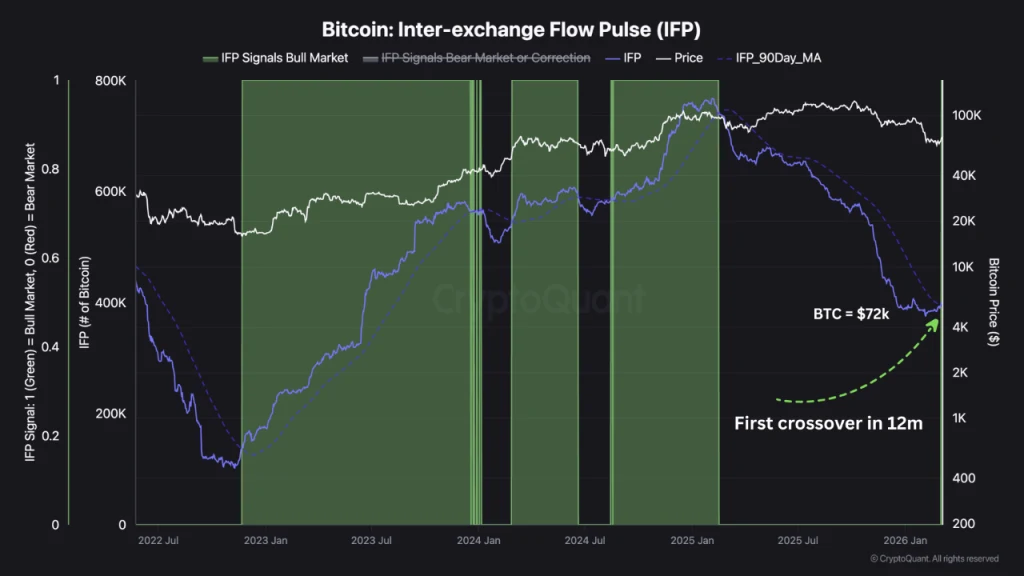
RugaResearch, another CryptoQuant analyst, reported that the Inter Exchange Flow Pulse (IFP) of Bitcoin has broken above its 90-day moving average for the first time in roughly one year. Analysts utilize the IFP to determine the movement of Bitcoin from spot exchanges to derivative exchanges. They seek to understand if there is a shift in speculative positioning.
If traders transfer their Bitcoin to a derivative exchange, they are usually looking to position themselves for a potential upside in Bitcoin price. In past cycles, when this type of crossover occurred, long periods of bull run in the Bitcoin market were typically seen.
However, RugaResearch explained that the signal itself does not indicate that a new high will occur rapidly. Typically, the period immediately following the initial crossover has historically shown short-term volatility prior to establishing a trend.
Source: CryptoQuant
Key Technical Test Ahead
According to RugaResearch, the first key technical area to be tested lies near $79,000, which is equivalent to the Trader On-chain Realized Price lower band. That same level acted as a cap to BTC earlier in the year when its price transitioned from approximately $80,000 to $98,000 before retreating.
If Bitcoin were to approach this zone once again, it would be important for market participants to assess the renewed derivatives flow. They need to know if it represents a genuine return of risk appetite or another brief spike in price.
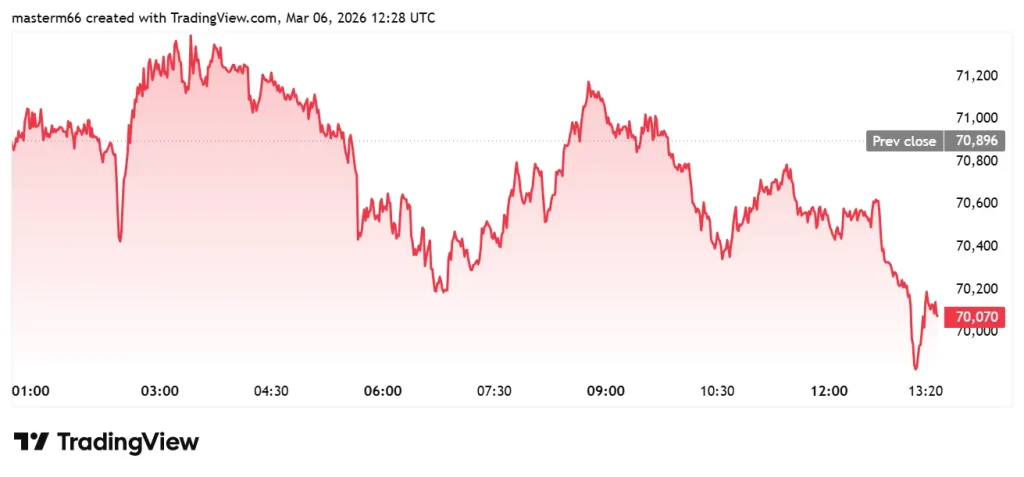
In the past, the IFP breaking above the 90-day moving average had indicated a renewal of interest in the asset by market participants. TradingView data shows that as of this writing, the BTC price is around $70,300 after experiencing a decline of 0.8% over the last 24 hours.
However, Bitcoin is still up by approximately 4.2% over the last seven days, indicating that the overall market momentum has not been completely reversed.
Source: TradingView
Why This Is Important
A combination of rising short-term holder selling and a bullish derivatives-flow signal provides evidence that BTC may be transitioning into a volatile phase in which profit-taking and risk appetite coincide.
Also Read | Bitcoin’s Resilient Bottom Formation: Unlocking Key Technical Indicators in Q1