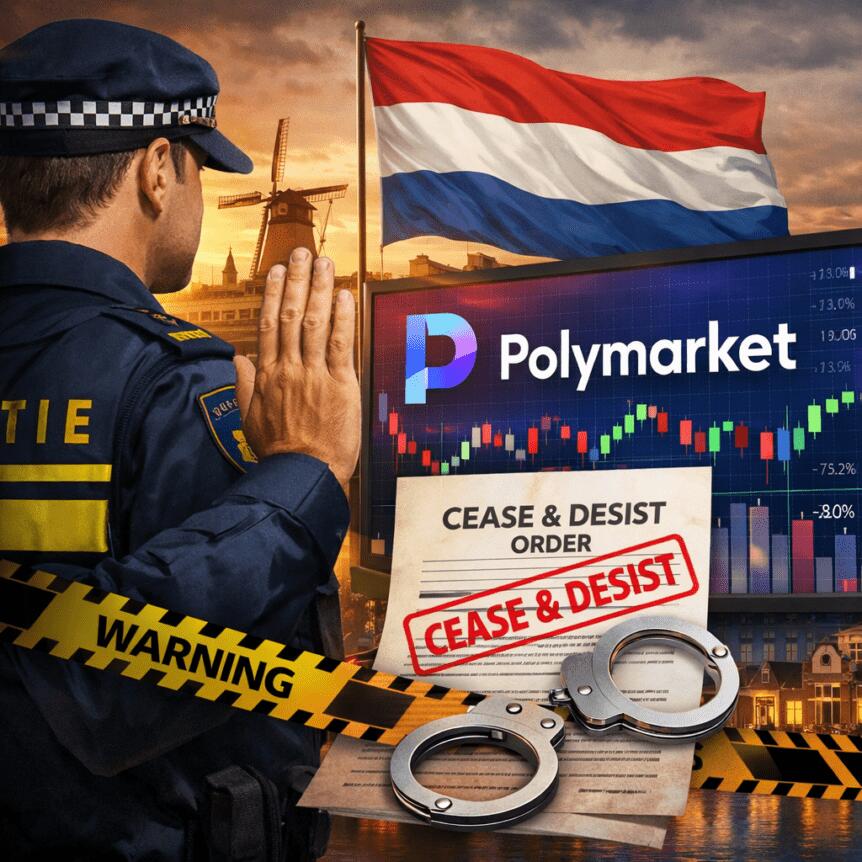
The Dutch gambling regulator has taken aim at a cryptocurrency-forward prediction platform, targeting its local arm for offering unlicensed gambling to residents. The Netherlands Gambling Authority accused Adventure One of Polymarket of marketing event-based bets without the required license, prompting a formal order to halt activities immediately and warning of steep penalties should the injunction be ignored. The action underscores the tension between innovative online prediction markets and national licensing regimes, a friction that regulators in multiple jurisdictions continue to scrutinize as crypto-based products gain traction. The enforcement also arrived amid broader domestic policy debates in the Netherlands over how to tax crypto investments, a topic that could reshape the financial landscape for digital assets if a proposed 36% capital gains tax clears the legislature and becomes law in 2028. Within days of the decision, lawmakers moved forward on the tax plan, framing the issue as part of a wider effort to bring crypto activity under clearer fiscal rules. The clash between a global platform and national regulators highlights how cross-border prediction markets navigate divergent legal environments while seeking to scale in regulated markets.
Key takeaways
- Netherlands Gambling Authority ordered Adventure One to cease “immediately,” with fines potentially reaching $990,000 for non-compliance.
- The regulator cited specific bets on local Dutch elections as part of the illegal offerings, noting no response from Polymarket to enforcement requests.
- Polymarket’s leadership signaled openness to dialogue with state authorities while federal courts in the United States weigh jurisdictional questions.
- Within a week of the Polymarket action, the Dutch House of Representatives advanced a 36% capital gains tax on investments that would likely include crypto assets, signaling growing tax scrutiny for digital assets.
- The case sits at the intersection of evolving regulation for prediction markets, global licensing regimes, and jurisdictions asserting control over the terrain where crypto-based bets live.
Tickers mentioned:
Sentiment: Neutral
Price impact: Negative. The immediate enforcement and potential fines constrain the operator’s Dutch activities and signal regulatory risk for similar platforms operating in the Netherlands.
Market context: The dispute unfolds as global authorities tighten oversight of prediction markets and crypto-related platforms, with U.S. regulators asserting jurisdiction even as state actions proliferate. The Netherlands’ move dovetails with ongoing debates over crypto taxation and licensing frameworks that influence international operators’ strategic choices.
Why it matters
The Netherlands’ abrupt intervention against Adventure One spotlights how prediction markets — platforms that allow users to place bets on future real-world events — are navigating a patchwork of national licenses and prohibitions. While such markets have expanded in several jurisdictions, unlicensed activity can trigger swift enforcement actions, creating a precedent for other operators that might be testing the boundaries of local gaming or securities law. The regulator’s decision emphasizes that even platforms with international footprints must respect domestic licensing rules when offering gambling products to residents, a principle that could shape the regulatory calculus for similar ventures across Europe and beyond.
For Polymarket, the event underscores a broader strategic risk: regulatory buy-in in some regions remains elusive, and the firm faces potential legal and financial penalties if it does not align its offerings with local requirements. The company has framed the tension as a jurisdictional question, signaling willingness to engage with authorities as courts in the United States weigh how such prediction markets should be regulated at the federal level. This stance reflects a broader industry pattern where operators seek clarity on how cross-border platforms can operate under varied regulatory regimes while safeguarding consumer protections and licensing standards. The tension between innovation and regulation is unlikely to dissipate soon, given the volume of political and regulatory attention on crypto-enabled financial products.
Beyond the enforcement action, the episode intersects with a domestic policy thread: the push to tax crypto investments more aggressively. The Dutch House of Representatives has moved forward with a proposal that would impose a 36% capital gains tax on investments, a category that would likely capture the gains from crypto trading and related digital-asset bets. If enacted and signed into law, the measure could take effect as early as 2028, reshaping the financial calculus for individuals participating in crypto markets, including those who engage in prediction-market activities. The regulatory and fiscal shifts together could influence where operators focus their growth efforts and how they structure user access to markets that hinge on real-world events, such as elections or policy announcements.
Analysts watching the Netherlands’ regulatory environment note that this action aligns with a broader global pattern: authorities are increasingly categorizing certain online prediction markets as gambling or financial products that require licensing, consumer protections, and robust compliance programs. The tension between federal regulatory ambitions in the United States and state-level experimentation adds another layer of complexity for platforms that operate in multiple jurisdictions. As policymakers weigh the appropriate boundaries for prediction markets, stakeholders anticipate continued legal disputes and evolving licensure requirements that will shape the architecture of future, crypto-enabled betting platforms.
For readers following the regulatory frontier, the Dutch case serves as a cautionary tale about the need to verify a platform’s licensing status before participating in event-based bets. It also highlights the importance of transparent engagement with regulators, as policymakers weigh how to balance innovation with consumer protection and tax compliance in a rapidly changing digital asset landscape.
What to watch next
- Polymarket’s formal response to the Dutch order and any subsequent steps the platform takes to address licensing concerns.
- Possible updates to the Dutch crypto tax framework and whether the 36% capital gains tax advances to become law in 2028.
- Potential regulatory alignments or conflicts between Dutch authorities and U.S. regulators as jurisdictional questions around prediction markets persist.
- Any future enforcement actions in the Netherlands or other EU states targeting unlicensed gambling or prediction-market activity.
Sources & verification
- Kansspelautoriteit (Dutch Gambling Authority) notice: “last onder dwangsom voor illegaal kansspelaanbod Polymarket” — https://kansspelautoriteit.nl/last-onder-dwangsom-voor-illegaal-kansspelaanbod-polymarket
- US CFTC leadership statements defending prediction markets — https://cointelegraph.com/news/cftc-michael-selig-defending-prediction-markets
- Polymarket commentary on jurisdiction and dialogue with states — https://x.com/HereComesKumar/status/2020845618789265743
- Polymarket-related lawsuit coverage and regulatory questions — https://cointelegraph.com/news/polymarket-s-lawsuit-could-decide-who-regulates-us-prediction-markets
- Dutch House advances 36% crypto tax — https://cointelegraph.com/news/dutch-house-advances-36-tax-law
What the story means for markets and regulation
The Netherlands’ move against Adventure One is a reminder that prediction markets, while innovative, remain squarely under regulatory scrutiny. As authorities in different jurisdictions refine licensing regimes and tax policies, platforms will need robust compliance programs to operate across borders. The broader regulatory backdrop — including ongoing debates about crypto taxation and jurisdictional authority over prediction markets — will likely influence how market participants structure bets, manage risk, and engage with policymakers in the months and years ahead. For investors and users, the episode reinforces the imperative to assess regulatory risk and to monitor statements from regulators and platform operators alike as the global landscape for crypto-enabled markets continues to evolve.
What to watch next
- Regulatory updates from the Netherlands on licensing for online betting and crypto-related platforms, including potential licensing reforms.
- Any official response from Polymarket regarding the Dutch order and its approach to compliance in Europe.
- Regulatory clarifications in the United States as courts weigh jurisdiction over prediction markets and enforcement actions expand at the state level.