

Ethereum’s validator entry queue has expanded sharply as major investors rush to stake rather than sell into recent price strength. As of March 4, 2026, around 3.4 million ETH are currently waiting to join the network’s validator set.
That backlog stretches activation times to roughly 60 days, according to data from ValidatorQueue.com. The figure shows one of the longest queues since the Ethereum transition to proof-of-stake.
In early January, the queue stood at approximately 904,000 ETH, but the latest information shows that demand has surged in a matter of weeks.
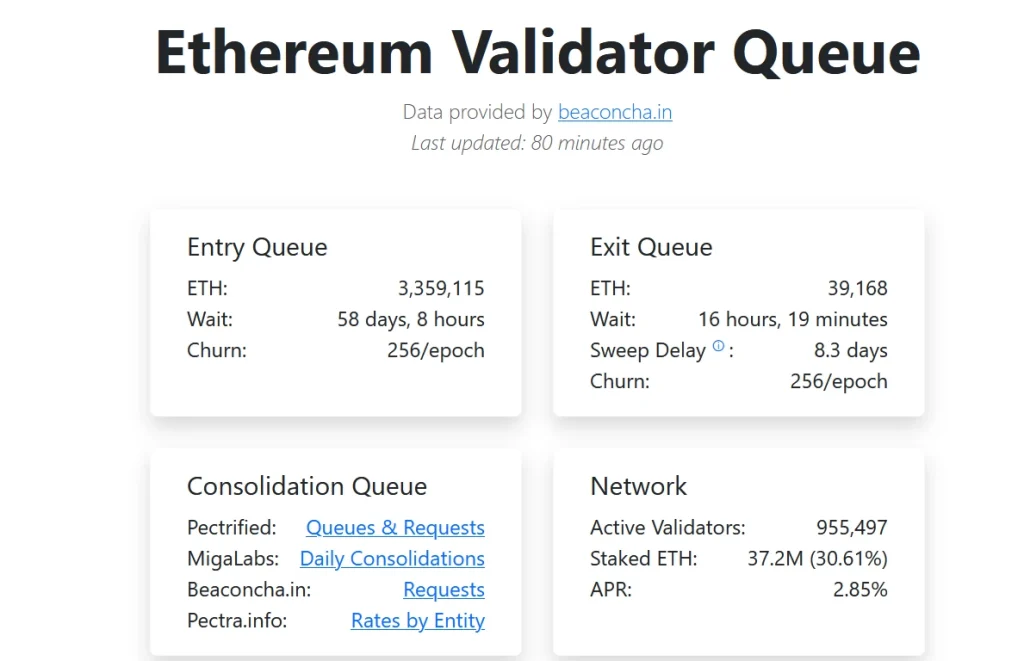
Validators are required to stake 32 ETH in order to secure the network, although the protocol limits the number of new validators, resulting in a queue when demand outstrips supply. The current queue indicates steady inflows from large investors looking to gain staking access.
Also Read: ONDO chart signals bullish move with $0.2781 as target
Corporates Lock Tokens to Generate Yield
The surge reflects a marked trend among large investors, companies, and cryptocurrency exchanges. Rather than allocating tokens during market rallies, the trend is to lock up tokens to farm yield.
Staking provides a way for balance sheet managers to earn on their balance sheets without having to lose market exposure. For institutional investors, the managers of large reserves, holding crypto idle comes at a price. Putting ETH into staking means that the validators can improve their capital efficiency while continuing to do their job.
The upgrade that took place last year, named Pectra, reinforced this dynamic. The upgrade allowed large operators to combine larger stakes into fewer validators. This made it easier for high-volume players to manage.
Market analysts believe that the current trend of stakeholder demand is a result of a strategic approach. By locking up their funds in the validator list, institutions show their faith in the Ethereum network while reducing the selling pressure.
Exit Queue Reversal Signals Capital Return
The current wave is a stark contrast to what happened in the previous year. In September, the validator exit queue reached a peak of close to 2.7 million ETH. This was a clear sign of withdrawals from staking in 2025.
However, by early 2026, the exit queue had dropped towards zero. The current reversal in progress indicates that capital has flowed back into Ethereum’s validator system. Rather than exiting, people are entering in large numbers once again.
Other macro stories may also help to stimulate interest. Ethereum’s role in payments infrastructure and AI-related apps has resonated. As these narratives continue to gain strength, it seems that investors are more receptive to allocating capital.
The growing validator queue effectively takes ETH off the circulating supply for an extended period. With delays in activation close to two months, millions of ETH are locked before they can claim rewards. This could have an impact on the liquidity environment in the short term.
Also Read: Pi Network Targets $0.212 as Bullish Setup Emerges