
The U.S. Securities and Exchange Commission approved generic listing standards for commodity-based ETPs on September 17–18, creating a clearer, faster pathway for exchanges to list spot crypto products that meet objective criteria. This shift reduces the need for one-off rule filings and lengthy comment cycles, which previously slowed non-BTC and non-ETH products. It materially changes the mechanics for any prospective Litecoin product moving through U.S. venues.
In this environment, analysts highlighted active Litecoin-related registration work. Reporting today notes Canary Capital’s amended S-1 for a spot LTC ETF with finalized details, framing it as near the “goal line” pending procedural steps. While ultimate outcomes remain with the SEC, the filing cadence now sits inside a friendlier ruleset that exchanges can apply generically.
Moreover, the rules change signals broader structural acceptance of crypto ETPs beyond the original pair of Bitcoin and Ether. As venues operationalize the standards across Nasdaq, Cboe BZX, and NYSE Arca, issuers gain a predictable checklist rather than bespoke pathways. For Litecoin, that means a realistic route from paperwork to listing once eligibility boxes are ticked.
Litecoin marks 14 years as the foundation amplifies builder funding
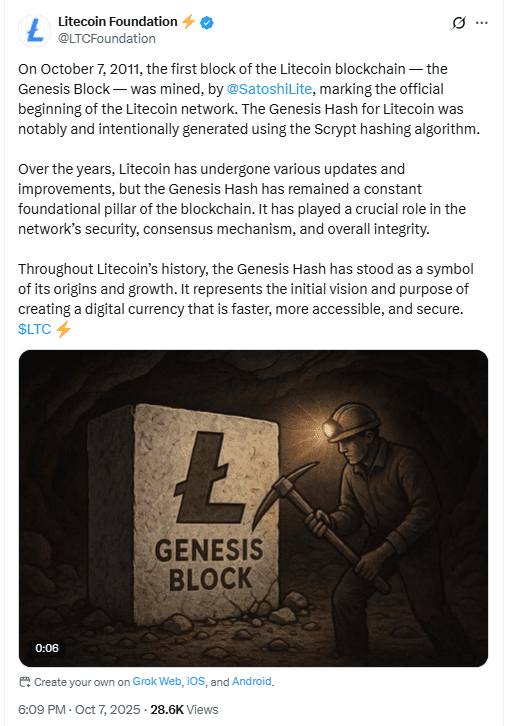
Litecoin turned 14 this week, with industry coverage and community posts pinning the genesis-block milestone to October 7, 2011. The date anchors Litecoin’s longevity and positions it among the longest-running proof-of-work networks still processing transactions daily. The anniversary renews attention on Litecoin’s role as an open-source, payments-focused chain.
At the same time, the Litecoin Foundation continues to lean into public-goods funding. Its projects portal outlines open-source initiatives and a multi-year matching-donation commitment from Charlie Lee designed to channel more resources into developer bounties and ecosystem work. The mechanism aims to pull more contributors into maintenance, tooling, and education around the protocol.
Additionally, founder commentary this fall revisited how today’s venture-backed token launches differ from Litecoin’s 2011 playbook. Charlie Lee argued that a “fair launch” would struggle in the current environment, which helps explain why the foundation foregrounds grants, donations, and collaborative building over token issuance. The perspective provides context for Litecoin’s funding model and its community-driven roadmap.
Ecosystem scope widens with L2 experiments and infrastructure focus
Beyond payments, developers continue exploring ways to extend Litecoin’s capabilities without changing its base-layer design. Community projects have proposed or launched layer-2 approaches—such as LitVM—to bring smart-contract functionality and Web3 rails to LTC. While these are not core-protocol upgrades, they illustrate a growing appetite to pair Litecoin’s settlement layer with programmable environments.
Furthermore, the network’s infrastructure footprint benefits from steady tooling and explorer coverage that make on-chain activity easier to observe and build on. Public explorers and project hubs help standardize data access, which in turn lowers friction for wallet, commerce, and analytics teams. In practice, this soft infrastructure often determines how quickly new use cases reach users.
Consequently, Litecoin’s non-price story today sits at the intersection of regulation, longevity, and developer pathways. The SEC’s ruleset offers a clearer route for any LTC ETP, the anniversary underscores operational durability, and the ecosystem’s L2 experiments and funding initiatives aim to broaden utility. Together, those strands shape how institutions and builders might engage the network next.
Litecoin hits resistance as Ali warns of $50 risk
Litecoin tested the upper band of its multi-month range this week, and trader Ali (@ali_charts) flagged the area as a potential rejection point that “could send Litecoin back to $50.” His post went live at 7:25 a.m. UTC on Oct. 8, 2025, and drew about 15.5K views shortly after. The accompanying chart marks a ceiling near roughly $120–$125, a mid-range cluster around $75–$85, and a lower support close to $50.
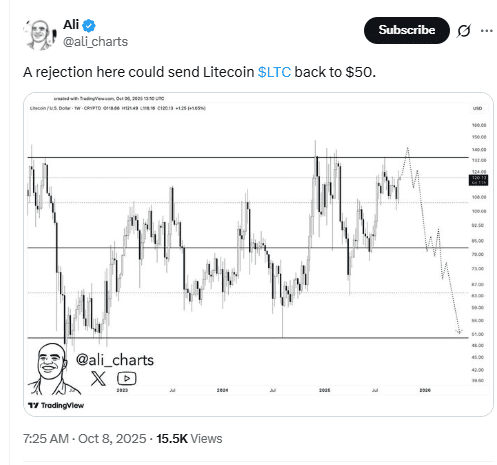
Moreover, Ali’s map shows repeated failures at the same horizontal band. Candles have pierced the zone several times in 2024–2025 but failed to hold weekly closes above it. In each case, downside follow-through carried price back toward the $80 neighborhood before probing lower.
Consequently, the setup frames a simple risk line: hold above ~$125 and invalidate the rejection, or lose momentum and rotate toward the $70s with scope to the $50 handle. The dotted path on Ali’s chart sketches that latter route in stages, first revisiting ~$85, then ~$70, and finally the ~$50 shelf if sellers regain control.
Range structure and levels define the path
The horizontal levels on Ali’s chart divide Litecoin’s action into three clear zones. The top band sits near $120–$125, where supply has capped advances multiple times since early 2024. The middle zone clusters around $75–$85, acting as the range’s balance area where rallies and pullbacks often pause. The lower shelf anchors near $50, which marks the chart’s deepest downside objective.
Furthermore, wick behavior at the ceiling underscores supply. On prior runs, intraday spikes above ~$120 quickly faded, leaving long upper shadows and weak closes. That pattern usually signals sellers stepping in with size as bids thin out at resistance, a dynamic that often precedes mean reversion toward the mid-range.
However, acceptance would change the script fast. Two or more strong daily closes above ~$125, with smaller upper wicks and expanding bodies, would argue that supply has finally been absorbed. In that case, the invalidation of the rejection thesis would reset targets higher and turn ~$120–$125 into first support on pullbacks.
What to watch next, per Ali’s schematic
Ali’s dotted arrows outline a measured cascade if rejection confirms. First, a slip back through ~$110–$105 would likely expose the $95–$90 pocket, where reactions have formed before. Then, continuation into the $80s would test the heart of the range; lose that area with momentum, and the lower magnet near $50 comes into play as his terminal downside marker.
At the same time, momentum confirmation matters. A swift expansion in range, shorter upper wicks near ~$115–$120, and heavier volume on down days would add weight to the rejection case. Conversely, a grind above ~$120 with firmer closes and shrinking intraday ranges would lean toward a breakout, directly challenging Ali’s caution.
In sum, Ali puts the risk-reward hinge at the ~$120–$125 band, quantifying downside at ~$50 if sellers win the test and upside if buyers finally clear the ceiling. The numbers are straightforward, the map is visible on the chart, and the decision now rests on whether Litecoin can secure sustained acceptance above the long-running cap Ali highlighted.