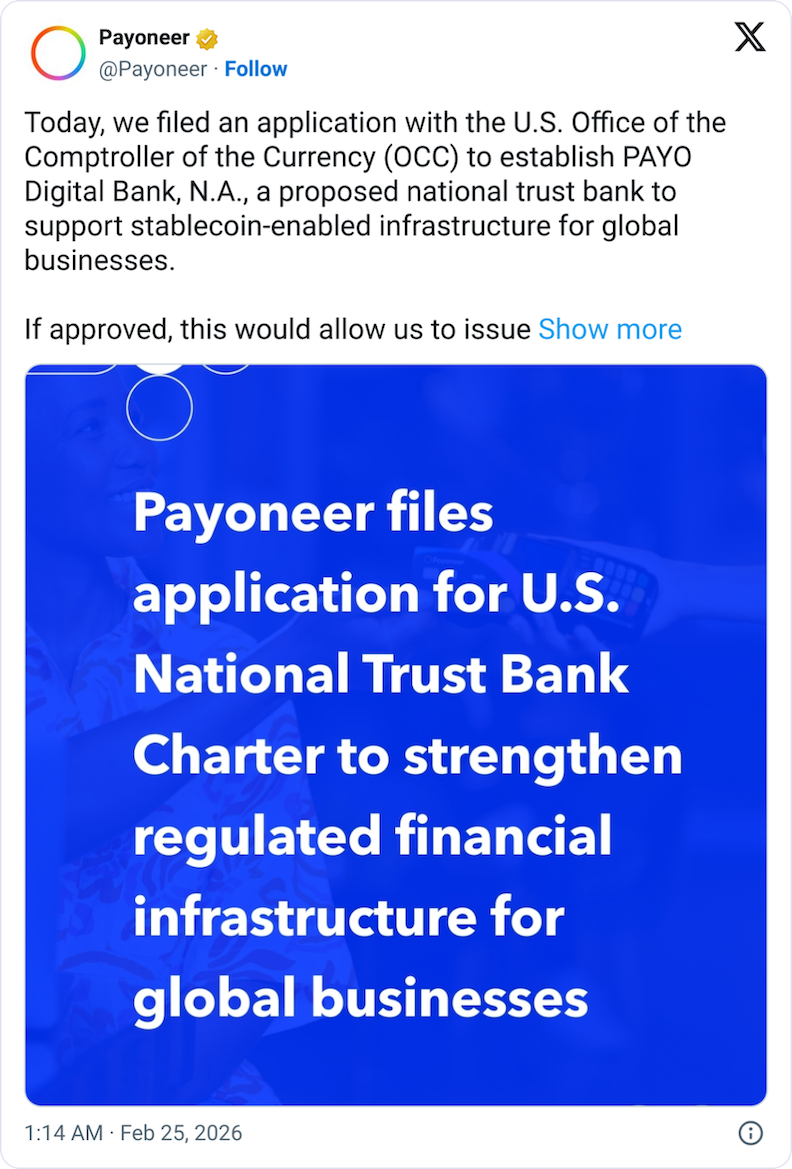
Global financial services firm Payoneer is the latest in a growing number of companies that have filed for a national trust banking charter in the US, which could enable it to issue a stablecoin and provide various crypto services.
Payoneer said on Tuesday it filed with the Office of the Comptroller of the Currency to form PAYO Digital Bank, a week after it partnered with stablecoin infrastructure firm Bridge to add stablecoin capabilities to its platform that is mainly focused on cross-border transactions.
Payoneer said that it is seeking to issue a GENIUS Act-compliant stablecoin, PAYO-USD, to serve as the holding currency in Payoneer wallets, in addition to allowing customers to pay and receive stablecoins.
OCC approval would also enable Payoneer to manage PAYO-USD reserves, offer custodial services and enable customers to convert between the stablecoins into their local currency.
“We believe stablecoins will play a meaningful role in the future of global trade,” said Payoneer CEO John Caplan.

The OCC gave conditional approval to Crypto.com for a charter on Monday, adding to the banking charters won by crypto companies Circle, Ripple, Fidelity Digital Assets, BitGo and Paxos in December.
Related: Better, Framework Ventures reach $500M stablecoin mortgage financing deal
The Trump family’s World Liberty Financial also applied for one in January to expand the use of its USD1 (USD1) stablecoin, but is still awaiting a decision.
Crypto trading platform Laser Platform also submitted an application in January, while Coinbase has been awaiting a decision on its application since October.
Stablecoins ideal for business cross-border transfers: Payoneer
Payoneer said OCC approval would allow it to offer its nearly two million customers, which are mostly small and medium-sized businesses, a regulated stablecoin solution to simplify cross-border trade.
“This offering will help advance the use of the USD in global trade, reduce barriers for American companies competing internationally, and expand the dollar’s presence across non-dollar payment corridors,” it said.
In December, Comptroller of the Currency Jonathan Gould said that new entrants to the federal banking sector was “good for consumers, the banking industry and the economy [as] they provide access to new products, services and sources of credit to consumers, and ensure a dynamic, competitive and diverse banking system.”
Magazine: Did a Hong Kong fund kill Bitcoin? Bithumb’s ‘phantom’ BTC: Asia Express