
A high-profile ban underscored Pump.fun’s tougher stance on safety and conduct. British streamer Sam Pepper lost access to Pump.fun following a widely circulated fireworks incident in Delhi, with other platforms also acting. The removal arrived within hours of the clip spreading, signaling faster escalation paths for violations.

The enforcement push follows weeks of scrutiny on extreme stunts across the broader creator economy. Coverage this month detailed how shock content can spill over into token launch pages, forcing venues to balance engagement with risk. As regulators and media focus on livestream harms, Pump.fun’s visible bans help frame new norms for its creator base.
Additionally, moderation changes align with tightened age-gating and stream rules reported since the feature’s 2025 relaunch. While not framed as a trading catalyst, these controls affect who can stream, how long sessions stay up, and what behavior triggers removal, shaping the platform’s day-to-day experience.
“Project Ascend” shifts earnings to creators
Project Ascend—the revenue model announced in early September—keeps rolling out to more creators. The framework replaces flat fees with dynamic tiers that raise creator take-rates as projects progress, aiming to reward sustained building instead of one-off hype. Third-party write-ups describe faster approvals and clearer rules on fee eligibility.

As adoption widens, the plan changes incentives across launch, streaming, and post-launch phases. Creators receive a more direct share of activity tied to their projects, while the platform retains tools to curb abuse. This design intends to keep activity high without relying on promotional spikes.
Moreover, the shift interacts with moderation: streams that breach policy now lose both visibility and potential earnings. That linkage channels attention toward compliant creators, which can stabilize content quality and reduce platform risk over time.
Company confirms another nine-figure buyback
Pump.fun executed and publicized another large token buyback this month, citing platform revenues as the source. Recent tallies put October repurchases at roughly $131–$138 million across multiple disclosures, with coverage noting a reduction in circulating supply and positioning the firm among 2025’s biggest crypto buyback spenders. The company framed the step as treasury management rather than a market call.
Operationally, buybacks intersect with the new revenue model by routing a portion of platform income back into the ecosystem. That flow supports longer planning cycles for creators and the company, independent of daily price moves. It also signals confidence in recurring fee generation from launches and streams.
Finally, the cadence of repurchases provides a measurable, on-chain-adjacent policy lever alongside moderation and fee design. Together, these tools define Pump.fun’s non-price story this week: stricter conduct rules, creator-first economics, and active treasury operations—all aimed at platform durability.
PUMPFUN intraday map: buyers defend $0.00328–0.00320, sellers cap $0.00415–0.00421
PUMP/USD trades inside a tight intraday range, with demand clustered at $0.00328–0.00320 and supply stacked at $0.00415–0.00421. The lower band aligns with a 4-hour level that previously caught sell-offs and produced quick bounces. The upper band matches a weekly high confluence plus a 4-hour resistance shelf that rejected advances twice this week.
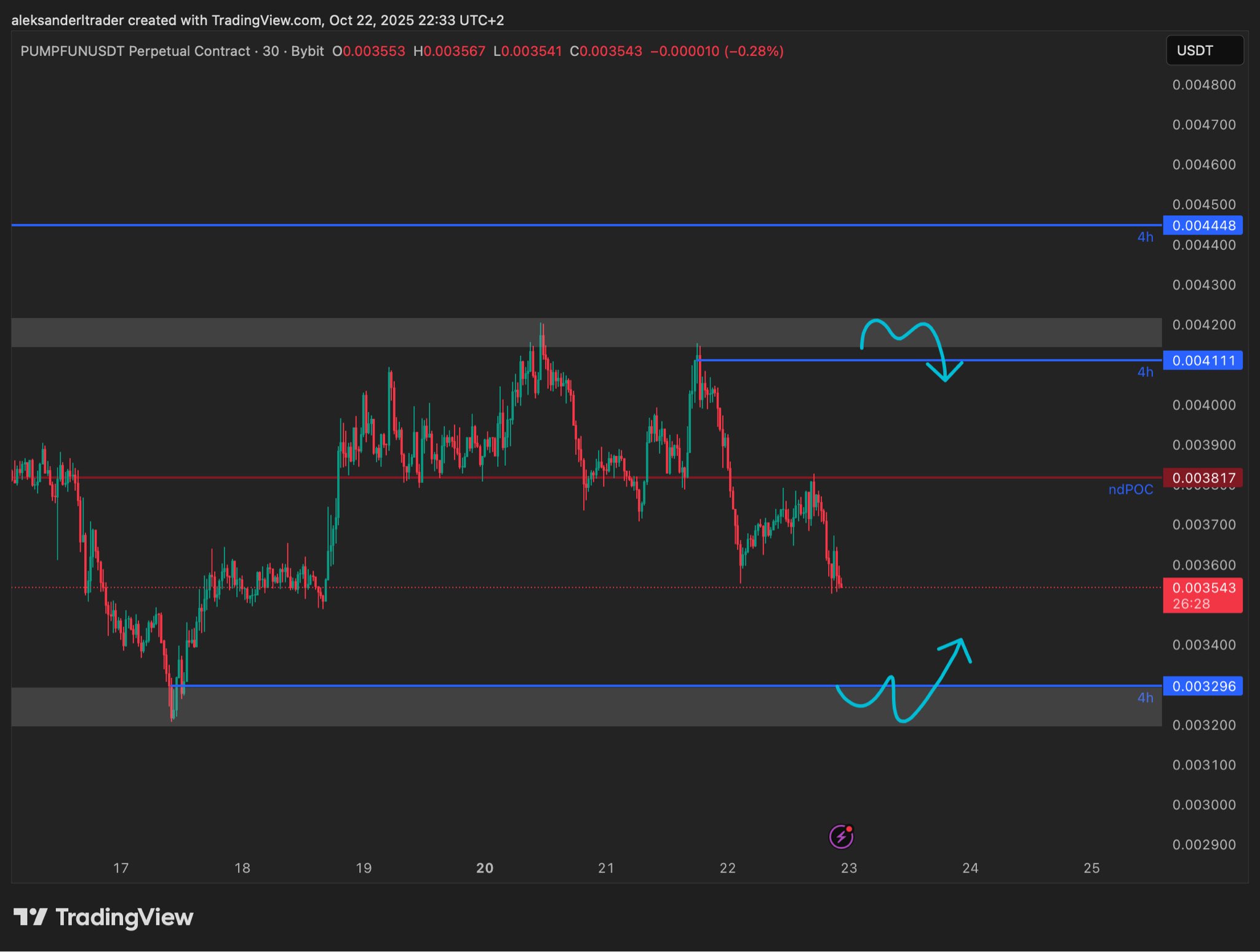
From here, the path of least resistance hinges on which band breaks first. If buyers absorb dips into $0.00328–0.00320 and print higher lows on 30-minute closes, momentum can rotate back to the mid-range near $0.00380 and then retest $0.00411–$0.00421. A clean acceptance above that ceiling, confirmed by a 4-hour close, would flip the structure and open room toward the next liquidity pocket around $0.00445.
Alternatively, if sellers push below $0.00328 and hold beneath it, the range loses its anchor. In that case, wicks into the gray demand zone are likely to fill, and price can probe the $0.00310s before stabilizing. Failure to reclaim $0.00328 after a breakdown would keep the bias defensive and invite a grind lower as bids step back.
Volume and candle closes should confirm the move. Expanding volume on a break through $0.00415–$0.00421 would signal genuine acceptance and reduce the odds of a quick fade. Conversely, a low-volume poke above the band risks a bull trap back into the range. Until one side wins, expect mean reversion between the zones with fast rotations and shallow follow-through.
PUMPFUN eyes breakout as price tests descending trendline
PUMP is pressing against a descending trendline on the 1-hour chart, and buyers are attempting to flip the level into support. The structure shows a clean series of higher lows forming beneath the trendline, which signals pressure building on the ceiling. If price stabilizes above the breakout line, momentum can extend toward the marked target area around recent local highs.
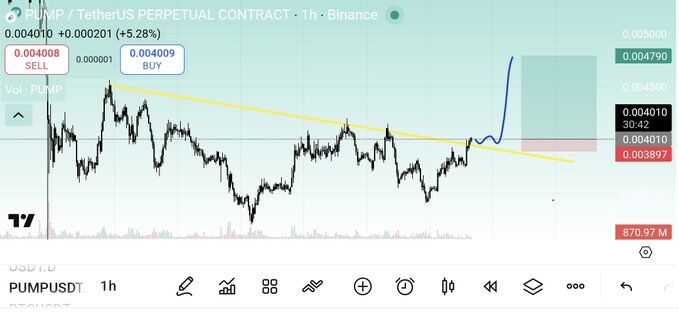
At this stage, the setup depends on holding the retest. A successful pullback and bounce would confirm bullish continuation, giving buyers control of the short-term narrative. In that scenario, the breakout could trigger a fast move into the next liquidity pocket, where prior stops remain uncollected. Volume expansion would strengthen the case, especially if candles close firmly above the trendline without long upper wicks.
However, the bullish path is not guaranteed. A failed retest would send price back inside the pattern and restore seller advantage. In that outcome, the chart would likely revisit support near the demand shelf that previously caught multiple lows. Until a clear confirmation arrives, the structure remains at a pivot point, with momentum favoring buyers but validation still required.