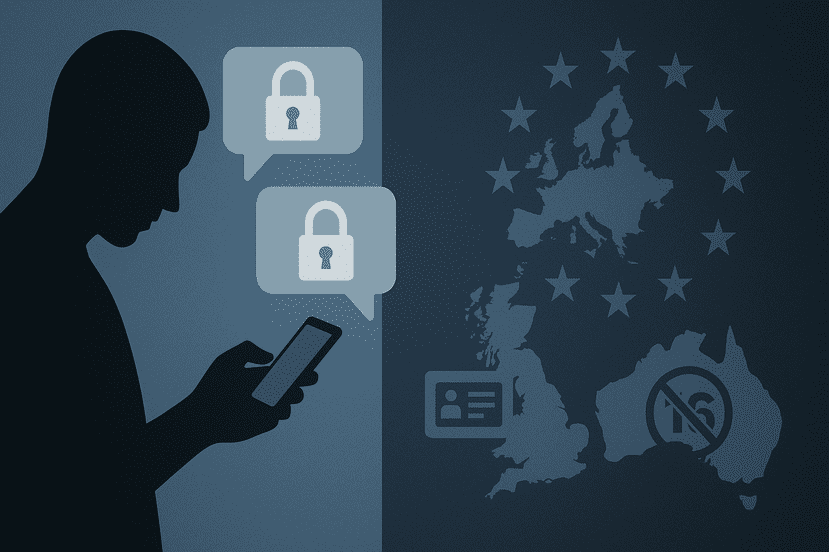
Pavel Durov says the free internet faces new limits. He cites EU Chat Control, the UK digital ID plan, and Australia age verification. He warns that rules target encryption, online speech, and basic privacy.
Durov flags Chat Control, digital ID, and age checks
Pavel Durov, the Telegram founder, posted his warning on X on Thursday. He wrote,
“I’m turning 41, but I don’t feel like celebrating.”
Durov added,
“Our generation is running out of time to save the free internet.”
He referred to EU Chat Control, UK digital ID, and Australia age verification. Durov said these measures change how people communicate online. He linked them to rising controls over encrypted messaging and online speech.
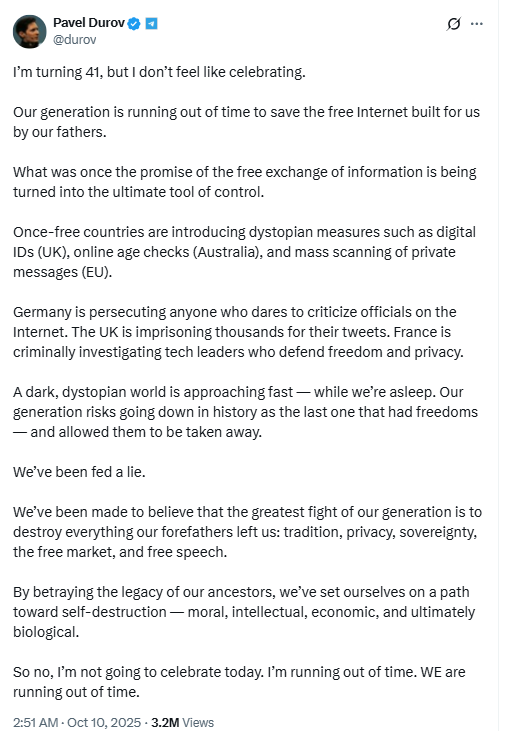
Durov used direct examples. He said Germany is prosecuting critics on the internet. He said the UK is imprisoning “thousands for their tweets.” Durov also cited France investigating tech leaders who defend privacy. He wrote,
“A dark, dystopian world is approaching fast — while we’re asleep.”
EU Chat Control: pre-encryption scanning and Germany’s 97 seats
EU lawmakers scheduled a vote on Chat Control. The proposal would require platforms to scan content before encryption. It would apply to Telegram, WhatsApp, and Signal under the plan.
The push met resistance this week. The head of Germany’s largest party moved against Chat Control. Germany holds 97 seats in the European Parliament. Therefore, its stance can block the measure at this stage.
Meredith Whittaker, president of Signal, called the setback meaningful. Yet she said “the war is not over.” The file now shifts to the European Council. The outcome there remains open, and timelines may change.
Encryption backdoor debate: Signal warns of data risks
Meredith Whittaker warned that scanning creates a dangerous backdoor. She said, “You can’t create a backdoor that only lets the ‘good guys’ in.” Whittaker pointed to a clear technical view on end-to-end encryption.
She said such systems open data security holes. Hackers and hostile nations can target those weak points. The risk extends beyond one app or country once scanning is mandated.
Security groups make a similar case. They say pre-encryption scanning undermines encrypted messaging by design. Once the pipeline exists, it can expand to more content. That change is hard to reverse across the EU.
UK digital ID: Keir Starmer’s plan and a 2.8 million-signature petition
In September, UK Prime Minister Keir Starmer announced digital ID. People would prove the right to live and work in the country. The plan also aims to speed access to public services.
The government app would store personal information. Officials say this would reduce delays and fraud. They link it to licenses, childcare, welfare, and tax access.
Critics cite privacy risks and scope creep. A petition opposing UK digital ID has over 2.8 million signatures. In the UK, any petition over 100,000 must be considered for Parliament debate.
Australia age verification: under-16 ban starts December 10
Australia plans to restrict social media for users under 16 from December 10. Policymakers argue this protects minors from harmful content. Enforcement tools include digital age verification.
The model may need documents or biometrics to verify age. That step creates new data security issues. Storage and vendor access increase exposure to breaches.
Critics point to the privacy trade-offs. They warn about cross-platform reuse of personal data. They also flag risks if verification links to identity at large scale.
Why encryption policies matter for Bitcoin and cryptocurrency privacy
Bitcoin operates with addresses rather than legal names. It supports peer to peer transactions without banks. These features rely on strong privacy norms and robust encryption.
Rules that require scanning or identity links can change that. Pre-encryption scanning and digital ID can build broader data trails. Those trails may connect wallets to identities at scale.
Crypto users and builders track these files closely. They see Chat Control, UK digital ID, and Australia age verification as key tests. Each touches encryption, privacy, and online speech in different ways.