
- Two SUI ETFs providing direct exposure to Sui’s native token began trading on February 18, 2026.
- SUI price correction could seek support at $0.87, followed by a dip to 0..73.
- The 20-day exponential volume average could act as a dynamic resistance against SUI buyers.
SUI, the native cryptocurrency of the SUI blockchain, is down 1.85% during Thursday’s U.S. market hours to trade at $0.9. The downtick followed shared macro pressures across the crypto market as Bitcoin extended correction to $66,000. While the SUI price faces a risk of prolonged correction, the recent launch of spot exchange-traded fund (ETFs), along with staking features should bolster this asset for renewed recovery.
Grayscale and Canary Launch First U.S.-Listed Sui ETFs With Staking Feature
Two U.S.-listed exchange-traded funds offering spot exposure to the SUI token, started trading this week on major exchanges.
Grayscale Investments turned its existing Sui trust into the Grayscale Sui Staking ETF (ticker: GSUI) and it began trading on NYSE Arca on February 18, 2026. The fund holds SUI tokens directly, which 100% of holdings will be allocated to staking on the Sui network from the beginning. It has a management fee of 0.35%, waived for the first three months or until assets under management reach one billion. Staking rewards are generated as a reward for the proof-of-stake mechanism within the network and are shared with shareholders in the form of net asset value adjustments.
Canary Capital has also launched its Canary Staked SUI ETF (ticker: SUIS) on Nasdaq, also starting trading on February 18, 2026. This is the first appearance of a spot based SUI product using the Investment Company Act of 1940 structure. The fund aims at tracking the spot price of SUI, while participating in staking activities, with the net rewards of validation reflected in the fund’s NAV. This way, investors can access both asset price movement and yields at the protocol level in a regulated manner.
Sui’s market capitalization is at about $3.6 billion as of mid-February 2026, and a considerable share of the circulating supply (about three-quarters) is already staked. ETF inflows would entail market purchases of SUI, which may be followed by staking which could further tighten available trading supply in an already limited float environment.
For some perspective, Bitcoin ETFs needed inflows of over $10 billion in order to create some significant structural changes in that market. Given Sui’s higher scale and distribution of tokens, similar inflows could have a proportionally greater impact on liquidity and trading dynamics, given they are significantly lower than $500 million (equal to 14% of current market cap).
SUI Price Faces A Risk of Prolong Correction
Since last week, the SUI price has plunged from $1.05 to current trading value of $0.91, registering a loss of 14.22%. This downtick indicates intact overhead supply and sell-the-bounce sentiment among market participants, signaling a risk of continued core support rection.
With sustained selling, the coin price could challenge the immediate at $0.87. The post-breakdown fall could seek support 16% down at $0.73, followed by a dip to a long-coming support at $0.67.
However, the falling price recorded diminishing trading volume since mid-February, indicating the lack of conviction from sellers to drive a sustained downtrend. If the volume fails to pace up, the coin price could seek a reversal opportunity at aforementioned supports.
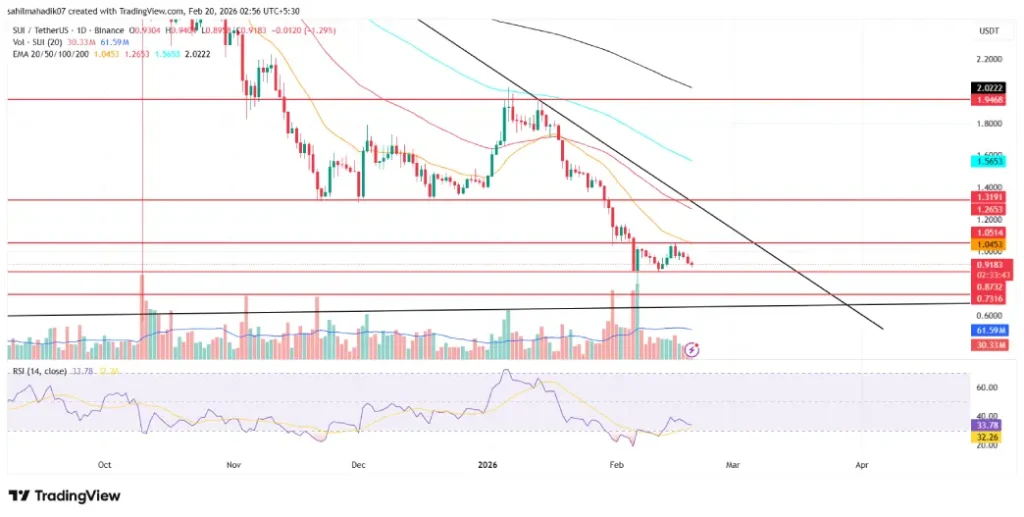
Along SUI ETFs inflow, the coin price must give a bullish breakout from the resistance trendline to renews sustainable recovery trend.
Also Read: Robinhood Chain Logs 4M Testnet Transactions in First Week, CEO Confirms