
US stocks are surging to record highs on AI and earnings optimism, while crypto sinks. Why is it happening, and what is the potential impact of such divergence on the broader crypto market? Let’s examine.
U.S. Stocks Rally on Rate Cuts and AI Demand
The S&P 500 and Nasdaq have been rallying, rising 0.4% each. At the same time, Bitcoin and Ethereum is down 2% and 7% in a week respectively, led by $1.5 billion of crypto liquidation in the past 24 hours.

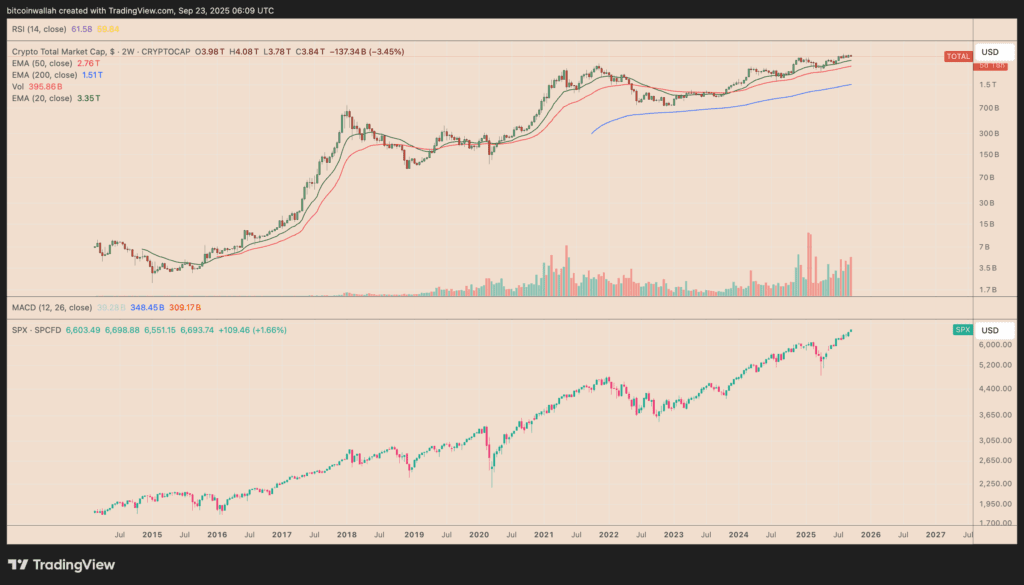
This kind of split has occurred before: riskier markets like crypto fall earlier, while equities continue higher. But history suggests the gap rarely lasts long. Either equities eventually decline to “catch down” with crypto, or digital assets recover sooner once liquidity improves.
Why the Fed’s Rate Cut Matters
On Sept. 17, the US Federal Reserve lowered its benchmark interest rate to 4.00%–4.25%, its first cut in nine months. Policymakers projected two more rate cuts before the end of 2025, bringing the rate closer to 3.5%–3.75%. For 2026, forecasts show another drop toward 3.25%–3.50%. This shift begins an easing cycle after years of tight policy meant to fight inflation.
Lower interest rates usually help markets by making borrowing cheaper, stimulating corporate investment, and supporting consumer demand. For stocks, especially growth sectors like technology, lower rates increase the value of future earnings. That explains why equities are rallying in anticipation of easier conditions.

For crypto, however, the picture is more complicated. Rate cuts typically improve liquidity, which is suitable for speculative assets, but inflation remains above target. Core inflation, which excludes food and energy, is still sticky. This creates uncertainty: if inflation does not fall further, the Fed may be forced to slow or halt its easing. Crypto, being highly sensitive to monetary policy, remains volatile under this uncertainty.
Why Stocks Are Rallying While Crypto Struggles
Stocks and crypto respond differently to the same macro signals. Earnings, dividends, and institutional flows back into equities. Large corporations like Apple, Microsoft, and Nvidia can generate profits and attract investors even when interest rates are high. The AI boom has fueled additional optimism, giving equities a structural reason to rise.

On the other hand, Crypto prices depends mainly on investor sentiment, liquidity, and adoption. With inflation still above target and the Fed easing only cautiously, investors are less willing to take on the additional risk of volatile assets like Bitcoin or Ethereum. This explains why stocks can rally while crypto plunges.
Leverage also plays a major role. In crypto, traders often use borrowed money to increase positions. When prices fall, these leveraged bets are liquidated automatically, which forces additional selling and deepens the decline. Stocks have margin trading too, but not on the same scale. This makes crypto downturns sharper and faster.
Regulatory Shifts Adding to Pressure
Regulation is another factor weighing on crypto. In mid-2025, the US passed the GENIUS Act, creating strict rules for stablecoins. The law requires securing assets to be audited regularly to fully back stablecoins. While this improves long-term credibility, it adds compliance burdens that may slow adoption in the short term.
The US Securities and Exchange Commission (SEC) has also streamlined the process for launching spot crypto exchange-traded funds (ETFs). This should make it easier for institutions to invest in Bitcoin and Ethereum. However, the transition period creates uncertainty as markets adjust to new structures. Meanwhile, the Treasury Department is seeking public input on stablecoin oversight through an Advanced Notice of Proposed Rulemaking, raising questions about how quickly rules will be finalized.
These steps show progress toward regulatory clarity, but in the near term, they can unsettle markets by adding costs and uncertainty.
History Shows Crypto Often Falls First — and Recovers Earlier
This is not the first time crypto has diverged from equities. In 2018, Bitcoin collapsed more than 70% after its 2017 peak, while US equities climbed through much of the year. By late 2018, however, stocks corrected as well, while Bitcoin had already bottomed.
In 2022, crypto collapsed following the Terra stablecoin disaster and major bankruptcies in the sector. Bitcoin and Ethereum fell months before equities experienced their sharpest downturns. By early 2023, crypto was stabilizing, once again bottoming before stocks.
The pattern is clear: crypto often reacts earlier and more sharply, while equities take longer to respond to macro forces.
What Might Happen Next
Two outcomes are most likely from here. If inflation remains stubborn and the Fed slows its easing, stocks could eventually “catch down” to crypto, leading to a broader market correction. On the other hand, if inflation continues to ease and the Fed delivers the expected rate cuts, crypto may rebound first. Its higher volatility means it often bounces earlier and stronger once conditions turn favorable.
The path will also depend on regulation. If the GENIUS Act and new SEC rules bring confidence without overburdening issuers, crypto could regain investor trust. However, if compliance proves costly or new restrictions emerge, it may prolong weakness.