
Canary Capital launched the first U.S. Exchange-Traded Funds (ETFs) for Litecoin (LTCC) and Hedera (HBR) on the Nasdaq, expanding regulated exposure to alternative cryptocurrencies beyond Bitcoin and Ethereum. Dogecoin (DOGE) could be the next in line for potential approval. Whether a Dogecoin ETF could follow — and if it does, can it push DOGE’s price higher? Let’s analyse.
Dogecoin ETF Filings and Regulatory Progress
Several asset managers are actively pursuing Dogecoin ETFs through different regulatory paths.
REX Shares, in partnership with Osprey Funds, has already launched the REX-Osprey DOGE ETF (DOJE) — the first U.S.-listed fund offering spot exposure to Dogecoin. The ETF, launched on Sept. 18, is structured under the Investment Company Act of 1940, uses regulated custody, and charges a 1.5% management fee. It recorded over $17 million in day-one trading volume, confirming strong initial demand for a memecoin-based ETF.
In parallel, 21Shares amended its S-1 filing for the TDOG ETF on Oct. 7, proposing to list it on Nasdaq with Coinbase Custody as the fund’s custodian. The firm allocated $1.5 million to purchase DOGE prior to launch. Grayscale Investments also submitted an updated S-1 filing for its GDOG ETF.
The U.S. Securities and Exchange Commission (SEC) missed its procedural review deadline on Oct. 18 due to the government shutdown, temporarily pausing several altcoin ETF filings. However, today’s Litecoin and Hedera ETF launches indicate that the SEC is continuing approvals under the generic listing standards rule.
This rule allows automatic listing for ETFs that meet exchange requirements for liquidity, custody, and real-time pricing transparency, without requiring a formal commission vote. Since Dogecoin already meets similar liquidity and custodian thresholds, analysts expect it to qualify for approval through the same pathway.
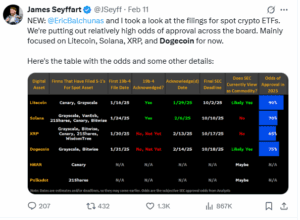
Bloomberg ETF strategist Eric Balchunas estimates a 99% probability of eventual approval for Dogecoin ETFs once review procedures resume.
Technical Setup Shows DOGE Resistance Near $0.25
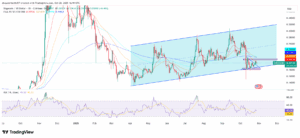
Dogecoin’s price has closely tracked ETF-related developments in recent months. It closed at $0.202 on Oct. 28 after several sharp rallies linked to ETF news.
-
On September 18, the day DOGE launched, DOGE price jumped 14.5% to $0.2557.
-
On October 7, DOGE gained 7.3% within 24 hours after 21Shares amended its filing.
-
In early September, DOGE advanced 5% amid reports of whale accumulation ahead of approval speculation.
Dogecoin continues to trade inside a broad ascending channel that has guided price action since April 2025. The coin is currently testing the lower boundary of that channel near $0.19–$0.20. Analysts identify $0.25 as immediate resistance and $0.30 as a breakout level that could trigger further momentum toward $0.86, if ETF-driven inflows persist.
How a DOGE ETF Could Influence Price
A Dogecoin ETF would allow investors to gain exposure to DOGE through regular brokerage accounts rather than crypto exchanges. This access could:
-
Increase liquidity, allowing larger trades without major price swings.
-
Attract institutional capital, as regulated funds can hold ETF shares even if they cannot hold crypto directly.
-
Stabilize spreads and volatility by linking Dogecoin’s trading volume with broader financial markets.
The success of Bitcoin and Ethereum ETFs supports this expectation. Together, they have attracted over $110 billion in assets since launch, showing that ETF access can translate into sustained capital inflows. Even a small share of similar volume could have a measurable effect on DOGE’s $30 billion market capitalization.
While approval optimism remains high, analysts warn that a “buy the rumor, sell the news” event could follow the official launch — a pattern seen with Ethereum’s ETF earlier this year. If traders have already priced in approval, DOGE could experience short-term profit-taking after the listing.
Long-term appreciation also faces structural limits. Dogecoin issues 10,000 new coins every minute, giving it an inflationary supply compared to Bitcoin’s capped model. Sustained growth would depend on consistent inflows and broader payment utility beyond speculation.