Two opposing forces on the XRP chart, an ascending support trendline formed from the recent February lows, and a descending 26-day exponential moving average acting as resistance, are creating a compression structure, as the asset has been trading in an ever-tighter range near the $1.40-$1.50 zone.
Price squeezed
As of this writing, XRP is trading at about $1.40, exhibiting little directional momentum but gradually reducing its trading range. Strong movements are usually preceded by this kind of market structure because the price is squeezed between convergent support and resistance levels. Volatility frequently rises quickly when this compression eventually resolves.
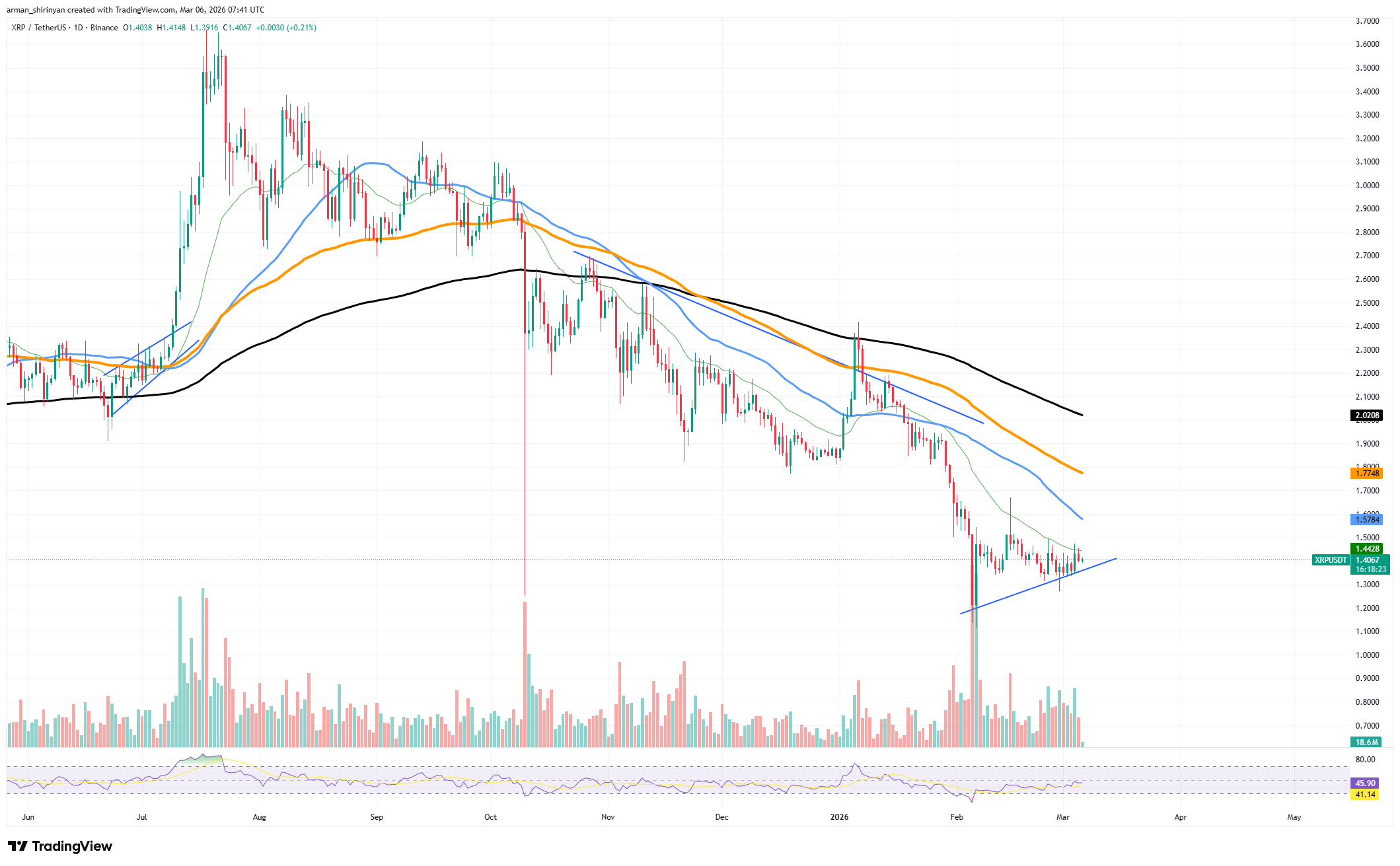
Bulls continue to face the 26 EMA as their main obstacle. Every attempt by XRP to rise over the previous few weeks has stalled close to this moving average, demonstrating its function as a dynamic resistance level. Since late 2025, the market has been dominated by a more general bearish structure, which is reflected in the indicator’s continued downward trend.
More challenges for sellers
Sellers are finding it more and more challenging to drive XRP considerably lower at the same time. The price is still supported by the rising trendline that developed following the decline in February. Every time XRP gets close to this point, buyers intervene to protect the structure, resulting in a series of higher lows.
You Might Also Like

A volatility squeeze is being created by the interaction between rising support and declining resistance. The $1.50 region has emerged as the focal point of this compression, serving as a transient price trap where the market fluctuates without settling on a definite course.
This arrangement gives investors the impression that a big decision might be coming soon. The market may see a sharp move toward the $1.60-$1.70 range, where more resistance clusters are found, if XRP is able to break above the 26 EMA and hold above the $1.50 area.
However, losing the rising trendline would render the attempt at a short-term recovery invalid and might push XRP back toward the $1.25-$1.30 support area.